





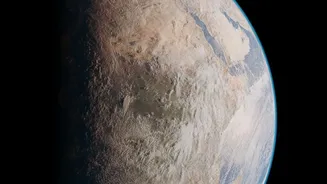

Meet the Super-Earth Next Door
LHS 1140 b isn't exactly new; it was discovered back in 2017. Located about 49 light-years away, it’s a 'super-Earth'—a rocky world significantly larger and more massive than our own. Specifically, it’s about 1.7 times Earth's radius and has over five
times its mass. It orbits its star, a cool red dwarf, every 25 days. While that sounds blisteringly fast, its star is so much dimmer than our sun that the planet sits comfortably within the 'habitable zone'—the orbital region where temperatures could allow liquid water to exist on the surface. For years, this made it one of the most intriguing candidates for further study.
The Red Dwarf Problem
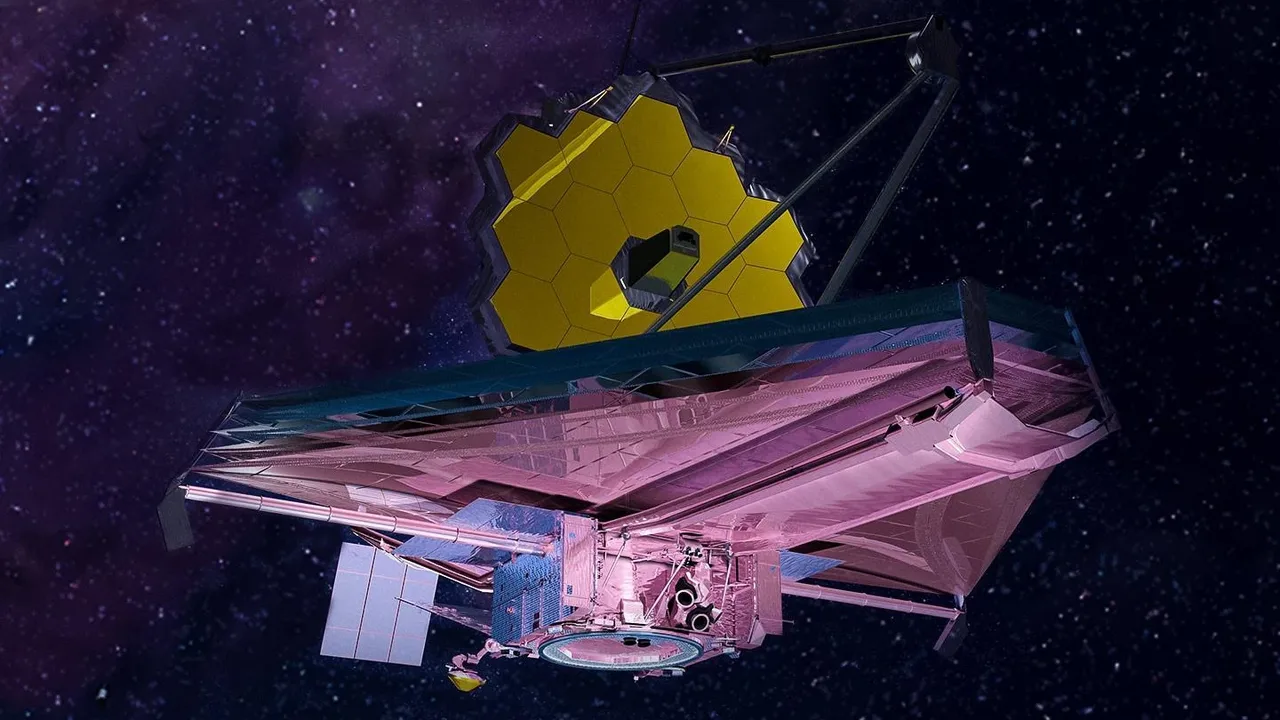
Finding a planet in the habitable zone of a red dwarf is a classic good news, bad news situation. The good news is that red dwarfs are the most common type of star in our galaxy. The bad news? They are notoriously volatile, especially in their youth. These stars are known for unleashing powerful flares and intense high-energy radiation that can blast away the atmospheres of any closely orbiting planets. For this reason, many astronomers were skeptical about whether planets like LHS 1140 b could hold onto a substantial atmosphere over billions of years, a key requirement for potential habitability. Many similar worlds studied by the James Webb Space Telescope (JWST) have turned out to be bare, airless rocks.
The Helium Hint
Instead of looking for an atmosphere directly, which can be incredibly difficult, a team of scientists tried a different tactic. They looked for a tell-tale sign of an atmosphere: escaping gas. Using the Magellan Clay Telescope in Chile, they observed the planet and found evidence of helium leaking from its upper layers. Helium is a light gas that naturally rises to the top of an atmosphere and slowly escapes into space, a process that also happens on Earth. The detection of this escaping helium was the strongest evidence yet that LHS 1140 b had successfully held onto a significant gaseous envelope for billions of years. This was a milestone—the first strong confirmation of an atmosphere on a rocky, habitable-zone world orbiting another star.
A Resilient World
The discovery is a game-changer. It proves that at least some planets around red dwarfs can survive their star’s violent youth and retain their atmospheres. The star LHS 1140 is itself relatively quiet now, which has likely helped the planet's atmosphere to stabilize over its estimated 5-billion-year life. Follow-up observations from the JWST have ruled out a thin, hydrogen-dominated atmosphere, suggesting a thicker, higher-molecular-weight atmosphere is present, possibly rich in nitrogen, water vapor, and carbon dioxide—similar to Earth's. This makes LHS 1140 b not just a curiosity, but a prime target for the next phase of exoplanet research: searching for biosignatures, the chemical fingerprints of life.