

Solving a Galactic Mystery
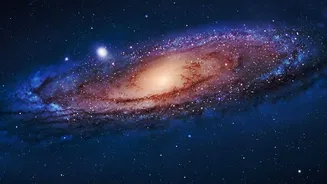
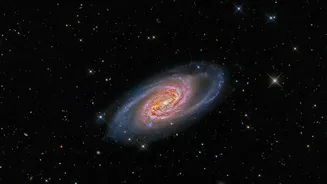
For years, astronomers have been puzzled by a strange feature of our galaxy. The main part of the Milky Way is a flat, spinning disk of stars, dust, and gas, rotating at a brisk 220 kilometres per second. But surrounding this disk is a vast, sparse sphere
of ancient stars called the stellar halo. Data from the European Space Agency's Gaia mission revealed that this halo barely seems to rotate at all, creeping along at only about 25 kilometres per second. This stark difference in speed didn't make sense. Now, a new study from astronomers at Durham University suggests a dramatic explanation: the entire galaxy was upended by a cosmic crash, and the slow-moving halo is the key piece of evidence.
The Ghost of a Galaxy
The culprit behind this cosmic disturbance was a dwarf galaxy that collided head-on with the young Milky Way about 10 to 11 billion years ago. Astronomers have nicknamed this intruder the "Gaia-Sausage-Enceladus" galaxy. The name comes from the sausage-like shape of the orbits its stars were thrown into after the merger. Though it was a "dwarf" galaxy, it was still immense, containing gas, stars, and dark matter with a mass more than 10 billion times that of our sun. The Milky Way tore the smaller galaxy to shreds and absorbed its stars, but the encounter was so violent that it left a permanent mark.
Recreating the Cosmic Crash
To connect the ancient Gaia-Sausage collision with the mystery of the slow-moving halo, the Durham University team used powerful supercomputer simulations. They ran models of 25 different galaxies similar to our own to see how they evolved over billions of years. The simulations, part of the Auriga project, showed a clear pattern: galaxies that experienced a major head-on collision, like the one with Gaia-Sausage, often underwent a "disc flip." This process involves the entire galactic disc tilting by more than 90 degrees over hundreds of millions of years. This gravitational upheaval effectively scrambled the motion of the stellar halo, leaving it with the slow rotation we observe today.
A New Chapter in Our History
This discovery fundamentally changes our understanding of the Milky Way's evolution. The collision with Gaia-Sausage was already known as the last major merger in our galaxy's history, responsible for creating the central bulge and much of the stellar halo. But the revelation that it may have also caused the entire disc to flip adds a dramatic new layer to that story. This means that billions of years ago, the path of stars—and possibly even our own sun's ancestors—was completely different from what it is today. Our seemingly stable place in the cosmos is the result of a chaotic and dynamic past, a history written in the slow, silent dance of the stars in the galactic halo.