
Mehrangarh Fort, Jodhpur
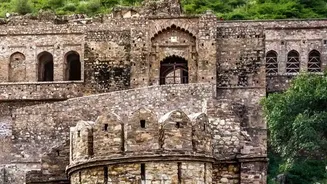
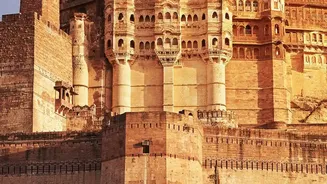
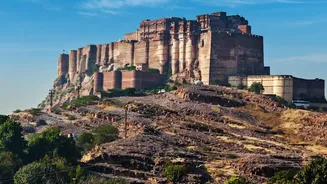
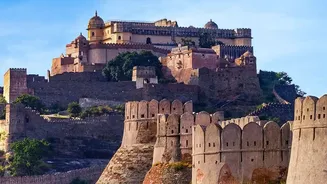
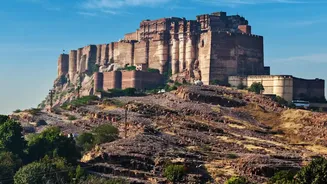
Perched on a 400-foot hill, Mehrangarh Fort seems to grow organically from the rock itself, its imposing sandstone walls blending seamlessly with the cliff. Founded in 1459 by Rao Jodha, the fort is a testament to Rajput grandeur. Inside its massive ramparts
lies a different world of intricate palaces like the Moti Mahal (Pearl Palace) and Phool Mahal (Flower Palace), filled with delicate carvings and expansive courtyards. The fort's museum houses an impressive collection of royal artefacts, but the real showstopper is the panoramic view of Jodhpur's famous "Blue City" below.
Jaisalmer Fort, Jaisalmer
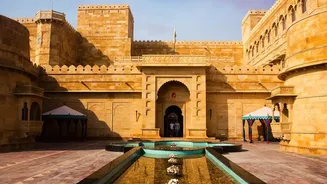
Known as 'Sonar Quila' or the Golden Fort, Jaisalmer Fort glows with a honey-gold hue as the sun sets over the Thar Desert. What makes it unique is that it's one of the few "living forts" in the world, with about a quarter of the old city's population still residing within its walls. Built in 1156 by Rawal Jaisal, its labyrinthine alleys are home to houses, shops, restaurants, and ancient temples. With its 99 bastions and triple-ringed defence architecture, it was a formidable desert outpost on ancient trade routes.
Amer Fort, Jaipur
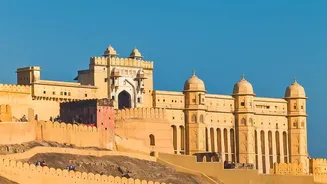
Overlooking Maota Lake, Amer Fort is a stunning blend of Rajput and Mughal architectural styles, constructed from red sandstone and marble. Built in 1592 by Raja Man Singh I, its grandeur is immediately apparent. The fort is famous for the Sheesh Mahal, or Mirror Palace, where thousands of tiny mirrors adorn the walls and ceiling, designed so a single flame could illuminate the entire room. Hidden tunnels even connect it to the nearby Jaigarh Fort, once serving as an escape route for the royals.
Chittorgarh Fort, Rajasthan
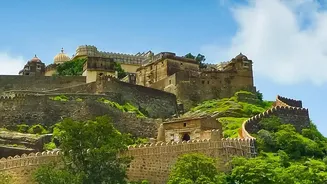
Sprawling across almost 700 acres, Chittorgarh is one of the largest forts in India and a UNESCO World Heritage Site. Its history, dating back to the 7th century, is filled with tales of Rajput valour, pride, and sacrifice. The fort witnessed three major sieges, with its inhabitants choosing honour over surrender, most famously in the legend of Rani Padmini's jauhar (mass self-immolation) during the siege of 1303. Within its vast enclosure are palaces, temples, reservoirs, and the iconic Vijay Stambh (Tower of Victory).
Golconda Fort, Hyderabad
Once the capital of the Qutb Shahi dynasty, Golconda Fort is an engineering marvel, particularly famous for its acoustics. A hand clap at the entrance's Fateh Darwaza (Victory Gate) can be heard clearly at the highest point of the fort, almost a kilometre away, a feature that served as an ingenious warning system. The fort was also a renowned centre for the diamond trade and is believed to have once housed the famous Koh-i-Noor diamond. Its ruins include majestic halls, stables, and an advanced water supply system.
Gwalior Fort, Madhya Pradesh
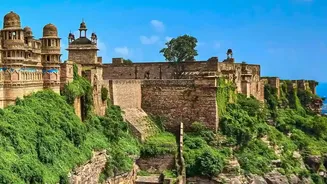
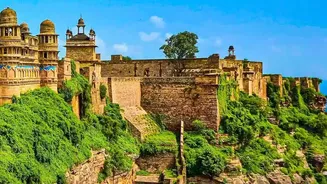
Often called the 'Gibraltar of India' for its commanding position on a steep, isolated sandstone hill, Gwalior Fort is one of the country's most formidable strongholds. With a history stretching back to at least the 8th century, it has been ruled by numerous dynasties, including the Tomars, Mughals, and Marathas. The fort complex is vast, containing several historic buildings, including the Man Mandir Palace with its striking blue-tiled exterior, the 9th-century Teli Ka Mandir, and massive Jain sculptures carved into the rock face.
Kangra Fort, Himachal Pradesh
Believed to be the oldest dated fort in India, Kangra Fort has a history that traces back over 3,500 years to the Katoch dynasty. As the largest fort in the Himalayas, it commands a strategic position at the confluence of the Banganga and Manjhi rivers. The fort has been coveted by invaders throughout history, from Mahmud of Ghazni in 1009 to the Mughals and later the British. Though heavily damaged in a 1905 earthquake, its ancient stone walls, seven gates, and temples still offer a breathtaking journey through time against the backdrop of the Dhauladhar mountain range.