




Understanding the New Visa-Free Policy
In a significant move to boost tourism and cultural ties, Uzbekistan announced a 30-day visa-free regime for Indian passport holders in late August 2026. This policy allows Indians to visit for tourism or short business trips without the need for an e-visa,
which previously cost around $20 and required a few days for processing. The initiative is part of a broader effort to strengthen the relationship between the two nations, which also includes a tourism cooperation program for 2026–2028 and robust flight connectivity, with about 14 direct flights per week linking the countries. While the policy has been officially announced, travellers are advised to confirm the exact start date and any specific entry rules with the Embassy of Uzbekistan before making non-refundable bookings. Standard international travel requirements, such as having a passport with at least six months of validity, will still apply.
A Crossroads of History and Culture
For centuries, Uzbekistan was the heart of the Silk Road, a vibrant artery connecting East and West. Its cities were melting pots of culture, science, and religion, leaving behind an architectural and cultural legacy that is second to none. The land was shaped by legendary conquerors and scholars, from Alexander the Great to Genghis Khan and the great Timur (Tamerlane), whose empire made Samarkand one of the most magnificent capitals in the world. This rich history is not confined to museums; it lives on in the sprawling turquoise-domed mosques, intricate madrasas, and bustling ancient bazaars. The cultural links with India are also deep, with institutions like the Lal Bahadur Shastri Centre for Indian Culture in Tashkent and a growing popularity of yoga.
Samarkand: The Jewel of the Silk Road
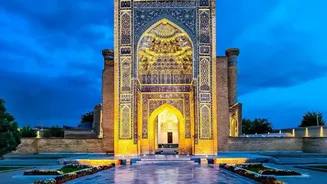
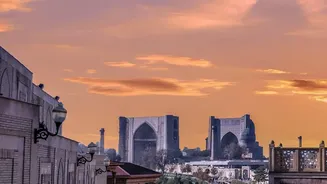
No trip to Uzbekistan is complete without visiting Samarkand. The city's undisputed centrepiece is Registan Square, an awe-inspiring ensemble of three grand madrasas (Islamic schools) adorned with dazzling mosaics and majestic domes. Other must-see sites include the Gur-e-Amir, the grand mausoleum of Timur, and the Shah-i-Zinda necropolis, a stunning street of tombs decorated with some of the finest tilework in the Muslim world. The enormous Bibi-Khanym Mosque, built by Timur's favourite wife, and the nearby Siyob Bazaar offer a glimpse into the city's medieval grandeur and modern-day pulse.
Bukhara: The Living Museum
Often described as an open-air museum, the old city of Bukhara is a wonderfully preserved example of a medieval Central Asian town. Its skyline is dominated by the 45-meter-high Kalyan Minaret, also known as the 'Tower of Death' from its history as a place of execution. The Po-i-Kalyan complex, which includes the minaret, a grand mosque, and a working madrasa, is a breathtaking sight. Visitors can wander through the maze-like alleys, explore ancient trading domes, relax by the Lyabi-Khauz pond, and admire the imposing Ark Fortress, the city’s oldest structure.
Khiva and Tashkent: A Tale of Two Cities
The city of Khiva offers a unique experience. Its inner town, Itchan-Kala, is a walled fortress that feels like a step back in time, completely sealed off from the modern world outside. With over 50 historical monuments, including the striking Kalta Minor Minaret and the Juma Mosque with its 218 wooden columns, it is a perfectly preserved slice of Silk Road history. In contrast, Tashkent, the capital, is a modern city with broad avenues and a blend of Soviet-era architecture and contemporary buildings. Key attractions include the historic Hazrati Imam Complex, the bustling Chorsu Bazaar, and the stunningly decorated Tashkent Metro stations, each a work of art in itself.
Practical Tips for Indian Travellers
The best times to visit Uzbekistan are during the spring (April to June) and autumn (September to October) when the weather is pleasant. While Uzbekistan is considered a budget-friendly destination, it is largely a cash-based economy, so it is wise to carry enough local currency (Uzbekistani Som). Don't miss out on the national dish, Plov, a hearty rice pilaf often cooked in giant cauldrons. A crucial rule for all foreign visitors is hotel registration. Licensed hotels will automatically provide you with a registration slip for each night's stay; you must keep these slips safe until you depart the country, as they may be checked by immigration officials.