

A Puffy Planet Far Away
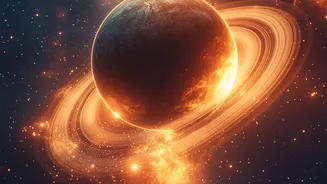
Imagine a planet almost twice as wide as Jupiter but with less than half its mass. Located about 1,300 light-years from Earth, WASP-17b is what astronomers call a 'puffy planet' or a 'hot Jupiter'. It orbits incredibly close to its star, completing a full
circle in just 3.7 Earth days. This proximity means it's tidally locked, with one side perpetually baked by its star's intense heat while the other faces the cold darkness of space. Its enormous size and extended atmosphere have made it an ideal laboratory for the James Webb Space Telescope (JWST) to study the weather on worlds beyond our own solar system.
Whispers of Extraterrestrial Jewels
Previous observations of WASP-17b's atmosphere had detected aerosols—tiny particles that form clouds or haze. In 2023, data from the JWST provided a startling discovery: the presence of quartz nanocrystals, a form of silica (SiO2). This was the first time such pure silica particles had been found in an exoplanet's atmosphere. While silicates, which form most of Earth's crust, are common in the galaxy, scientists expected to find magnesium-rich silicates, not pure quartz. The idea of a world with clouds of quartz, the same mineral that makes up many of Earth’s gemstones, was a thrilling prospect and captured the public's imagination. These crystals were not lifted from a surface but formed directly from gas high in the scorching 1,500°C atmosphere.
A Deeper, Three-Dimensional Look
The latest breakthrough comes from a new analytical technique called 'transmission strings' or transit mapping. Instead of averaging the starlight that filters through the planet’s atmosphere during a transit, this method allows scientists to map the atmospheric edge from different angles. This provides a much more detailed, 3D view of the planet's atmospheric structure. The research, co-led by the University of Bristol and Cornell University, has revealed that WASP-17b's atmosphere is not a perfect sphere. Instead, it is asymmetrical, distorted by the planet's extreme weather.
From 'Gems' to Wind-Blown Bulges
The new 3D map provides a more nuanced explanation for the earlier findings. The 'gemstones' are not literal gems floating in a specific spot, but rather a feature of the atmospheric model that highlights a specific area of interest. The map shows a significant bulge in the atmosphere on the planet's 'evening' side—the area where the permanent dayside transitions to the nightside. Powerful winds, potentially moving at thousands of miles per hour, transport super-heated gas from the dayside around to the nightside. This intense heat causes the atmosphere on the evening side to expand and puff out, while the 'morning' side, which has cooled after traversing the night, is less extended. The so-called 'gem' that earlier models hinted at is this hot, inflated region, which the new mapping technique can now precisely locate and explain as a dynamic weather feature.
Why Seeing in 3D Matters
This discovery is more than just a weather report for a distant world. It serves as a 'proof of concept' that planets are complex 3D objects and that our theoretical models of their atmospheres are remarkably accurate. Lead author Lili Alderson noted that WASP-17b's temperature difference between its morning and evening sides is 'pretty much bang-on what we thought it would be'. By successfully mapping WASP-17b's atmospheric shape, scientists have shown they can move beyond computational exercises and begin to truly observe the complex dynamics of alien climates. This new method opens the door to creating similar 3D weather maps for many of the thousands of other exoplanets discovered to date, bringing us a step closer to understanding the vast diversity of worlds across our galaxy.