



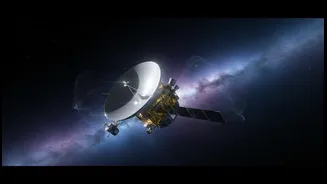


An Encore Beyond Pluto
After its historic and wildly successful flyby of Pluto, the New Horizons mission could have been considered complete. But the spacecraft was healthy, and NASA is known for getting every last drop of science from its resilient explorers. In 2019, it performed
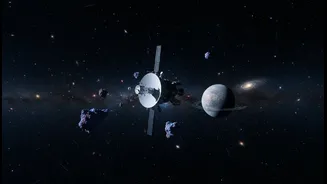
another flyby, this time of Arrokoth, the most distant object ever explored up close. This established New Horizons as more than a one-hit wonder, proving its ability to conduct meaningful science deep in the Kuiper Belt, the icy outer-fringe of our solar system. But with no other reachable flyby targets on its path, a new purpose was needed for this veteran explorer.
A New Mission: Heliophysics
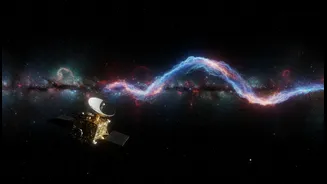
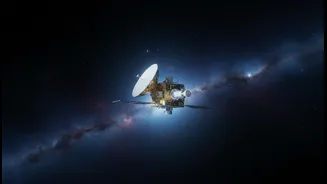
In late 2023, NASA officially redirected the mission. New Horizons would shift its primary focus from planetary science to heliophysics—the study of our sun and its vast influence on space. In July 2026, after a 321-day hibernation to conserve resources, the spacecraft woke up healthy and ready for its new assignment, some 9.5 billion kilometres from Earth. Its new role is to act as a unique deep-space observatory, providing data from a region no other active mission is exploring. The goal is to continue this mission until at least 2028 or 2029, when the spacecraft is expected to finally exit the Kuiper Belt.
What is the Heliosphere?
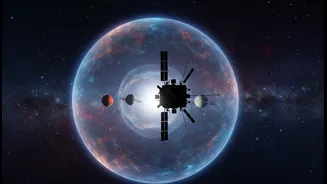
So, what is it that New Horizons is now studying? Imagine a giant, protective bubble blown by the Sun that envelops all the planets. This bubble is the heliosphere. It's formed by the solar wind, a constant stream of charged particles flowing outward from the Sun. This bubble acts as a crucial shield, protecting planets like Earth from a significant amount of harsh galactic cosmic radiation coming from interstellar space. The heliosphere extends far beyond Pluto, and understanding its structure, its boundary with interstellar space (the heliopause), and how it interacts with the galaxy is a key scientific frontier.
Science on the Outer Edge
Even while hibernating, New Horizons was busy. Its plasma and dust detectors were continuously active, gathering information about the solar wind and dust environment in the outer heliosphere. Now fully awake, the probe will first send back its treasure trove of stored data—a process that will take time, as a one-way signal takes nearly nine hours to reach Earth. In the coming weeks, its ultraviolet spectrograph will begin a new campaign to observe how hydrogen gas is distributed at this immense distance. These measurements are invaluable because New Horizons offers a perspective that simply isn't possible from Earth, or even from the legendary Voyager probes which are now much further out and have different, older instruments.
A Unique Point of View
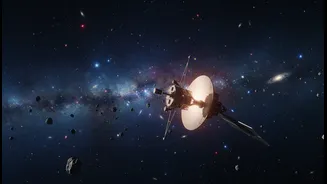
New Horizons is in a perfect position to study the heliosphere from the inside. It travels through a region that the Voyager 1 and 2 spacecraft passed through years ago, but New Horizons carries more advanced plasma-measuring instruments. This allows it to make first-of-their-kind measurements of so-called 'pickup ions,' which are crucial to the structure of the heliosphere but which the Voyager probes were not equipped to study directly. By combining its real-time data with the past readings from Voyager, scientists can build a much richer, multi-point picture of our solar system's protective bubble and how it behaves.