




The Cosmic Ghost Particle
First theorized in 1930 by Wolfgang Pauli to explain why energy seemed to vanish during radioactive decay, the neutrino is one of the strangest particles known to science. Having almost no mass and no electrical charge, they are extraordinarily difficult
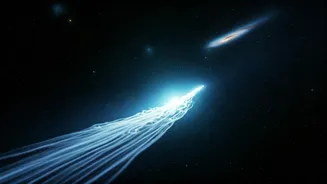
to detect. They stream through planets, stars, and entire galaxies without interacting with much of anything, earning them the nickname 'ghost particles'. While most neutrinos that reach Earth are lower-energy particles from our own sun, scientists have long been puzzled by the origins of rare, high-energy neutrinos that come from deep space. These particles are cosmic messengers, carrying information from the most violent events in the universe, and finding their source has been a century-long quest.
Meet the Shadow Blaster
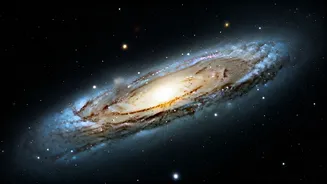
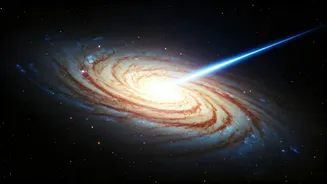
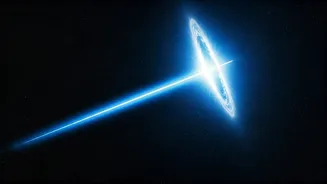
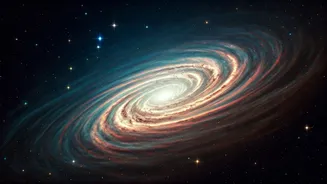
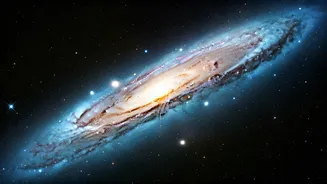
The 'Shadow Blaster' is the informal name given to a distant, powerful source that scientists now believe is a major clue in the neutrino mystery. More formally, this object is a type of blazar. A blazar is a specific kind of active galactic nucleus (AGN), which sits at the heart of a galaxy. It's powered by a supermassive black hole that is actively feeding on surrounding gas and stars. As this material spirals into the black hole, it heats up and shoots out a colossal jet of ionized matter at nearly the speed of light. A blazar is what we see when one of these incredibly bright, high-energy jets happens to be pointed directly at Earth. The nickname 'Shadow Blaster' emerged because the event that created the neutrinos was obscured by a thick veil of cosmic dust, making it invisible to traditional optical telescopes.
A Groundbreaking Detection
The connection was made thanks to giant, unconventional telescopes. The IceCube Neutrino Observatory, buried a mile deep in the Antarctic ice, uses over 5,000 optical sensors to monitor a cubic kilometer of ice. It doesn't see neutrinos directly. Instead, it watches for the faint flash of blue light, called Cherenkov radiation, that is produced when a neutrino occasionally crashes into an ice atom. By analyzing the light pattern, scientists can reconstruct the neutrino's energy and its original direction. In a recent breakthrough observation, a very high-energy neutrino was detected by IceCube, and its trajectory was traced back to the location of the 'Shadow Blaster' blazar. This provided strong evidence linking these powerful cosmic accelerators to the production of high-energy neutrinos.
The Dawn of a New Astronomy
This discovery is a landmark achievement for a new field called multi-messenger astronomy. For centuries, we have studied the universe almost exclusively by observing light across the electromagnetic spectrum. But now, scientists can combine information from different 'messengers'—light, neutrinos, and even gravitational waves—to get a more complete picture of cosmic events. When a high-energy neutrino is detected, observatories around the world can be alerted to point their telescopes (radio, gamma-ray, and optical) toward the suspected source. This coordination was crucial in confirming the 'Shadow Blaster' as a likely source. By studying both the particle (the neutrino) and the light (gamma rays) from the same event, physicists can test theories about how these cosmic accelerators work in ways that were previously impossible.
Why This Cosmic Clue Matters
Pinpointing the source of high-energy neutrinos helps solve one of the biggest mysteries in astrophysics: the origin of ultra-high-energy cosmic rays. Cosmic rays are particles, like protons, that have been accelerated to immense energies. When these cosmic rays crash into gas or light surrounding their source, they can produce both gamma rays and high-energy neutrinos. Because neutrinos are neutral, they travel in a straight line from their birthplace, unaffected by the powerful magnetic fields that bend the paths of charged cosmic rays. This makes neutrinos perfect pointers, guiding us back to the cosmic engines that forge the most energetic particles in the universe. The 'Shadow Blaster' clue suggests that dust-obscured, star-forming galaxies and their central blazars could be a major source of the high-energy neutrino background seen across the universe.