
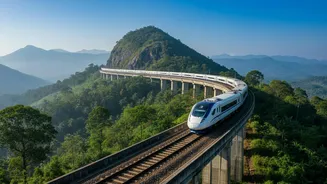
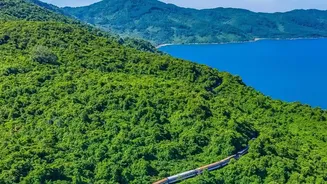

A Legendary and Treacherous Route
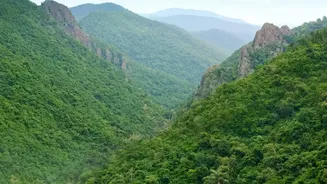
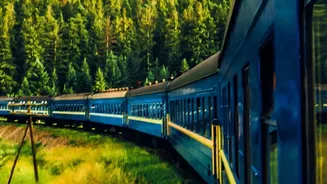
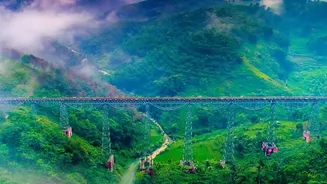
The railway line connecting Sakleshpur and Subrahmanya Road is not just another track; it's a 55-kilometre engineering marvel cutting through the dense Western Ghats of Karnataka. Known for its breathtaking scenery, the line is equally famous for its operational
challenges. It features a staggering 57 tunnels, over 226 bridges, and 108 sharp curves packed into a relatively short distance. This section, often called the 'Green Route', was originally a metre-gauge line before being converted to broad gauge. Its geography makes it one of the most technically demanding railway sections in the entire country, a place where nature constantly tests the limits of machinery.
The Gradient Gauntlet
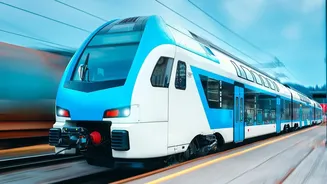
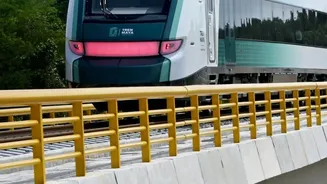
The single biggest challenge on this line is its steepness. The route has a ruling gradient of 1 in 50, which means for every 50 metres the train travels forward, the track rises or falls by one metre. This might not sound like much, but in railway terms, it's a severe incline. For conventional trains, navigating such slopes requires extra power. Typically, 'banker' locomotives—additional engines—are attached at the rear to help push the train up the ghat and provide controlled braking on the way down. However, the Vande Bharat Express is a self-propelled trainset with an integrated, aerodynamic design. Attaching and detaching banker locos would be impractical and time-consuming, defeating the purpose of a rapid-transit service. This means the Vande Bharat must rely entirely on its own power and braking systems to master the climb and descent.
A Special Test for a Special Train
Recognising this unique challenge, Indian Railways is conducting intensive trials with a specially modified 20-car Vande Bharat rake. The key modification is the inclusion of an Automatic Emergency Braking (AEB) system. The Commissioner of Railway Safety has mandated a maximum speed of just 30 km/h on this treacherous section. The AEB system acts as a crucial safety layer, automatically applying the brakes if the train exceeds this speed limit, preventing any chance of it losing control on the steep gradients. Personnel from the Research Designs and Standards Organisation (RDSO) are on board for these trials, which are running until August 20, 2026, to meticulously examine every parameter of the train's performance, from acceleration and stability to braking efficiency under monsoon-like conditions.
More Than Just an Uphill Battle
Beyond the gradients, the route is also highly prone to landslides, soil erosion, and rockfalls, especially during the heavy monsoon season. The frequent curves and numerous tunnels add another layer of complexity, demanding constant adjustments in speed and power. The recent electrification of this section, completed in late 2025, was itself a massive engineering feat due to the inaccessible terrain. For the Vande Bharat, this means not only testing its motor power and brakes but also its resilience in an unpredictable environment. The train's standard electro-pneumatic and regenerative braking systems, which feed power back into the overhead wires, are being pushed to their absolute limits.
The Bigger Picture for Indian Railways
The successful completion of these trials is about more than just starting a single new service between Bengaluru and Mangaluru. It's a proof of concept. If the Vande Bharat can safely and efficiently operate on the Sakleshpur-Subrahmanya line, it opens up the possibility of introducing similar high-speed services across other challenging ghat sections in India without the need for banker locomotives. It would be a major validation of the train's advanced engineering and adaptability. Success here would pave the way for faster, more reliable connectivity to remote and coastal regions, truly integrating them into India's modern railway network.