



The Reigning Champion: The Giant-Impact Idea
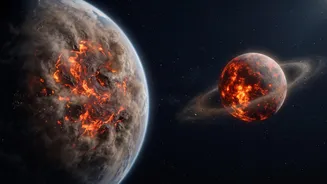
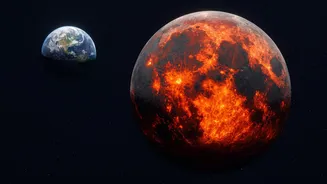
For decades, the leading explanation for the Moon's existence has been the Giant-Impact Hypothesis. The story goes that about 4.5 billion years ago, when our solar system was a chaotic construction zone, a Mars-sized protoplanet named Theia slammed into
the young Earth. This colossal, grazing blow ejected a massive amount of molten rock and debris into orbit. Over a period of months or years, gravity worked its magic, causing this debris to clump together, eventually forming the Moon we see today. This model elegantly explained several key observations, including the Earth-Moon system's angular momentum and why the Moon has a relatively small iron core. For a long time, it was the best story we had.
A Problem of Chemistry
But the giant-impact model has a persistent flaw, often called an "isotope crisis." Isotopes are versions of elements with different masses, and their ratios act like a unique fingerprint for every planetary body. The problem is, analysis of Apollo lunar samples shows that the Earth and Moon are almost isotopic twins. Their oxygen, titanium, and other elemental fingerprints are strikingly, almost identically, similar. If the Moon was formed mostly from the debris of a foreign body (Theia), as early simulations suggested, it should have a different isotopic signature from Earth. Scientists were left with a major puzzle: why does the Moon look so much like it was made from Earth material, when the leading theory said it came from a distinct impactor?
Enter the Synestia: A New Twist
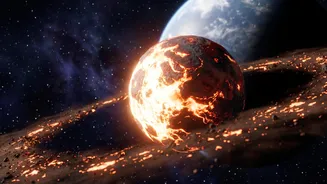
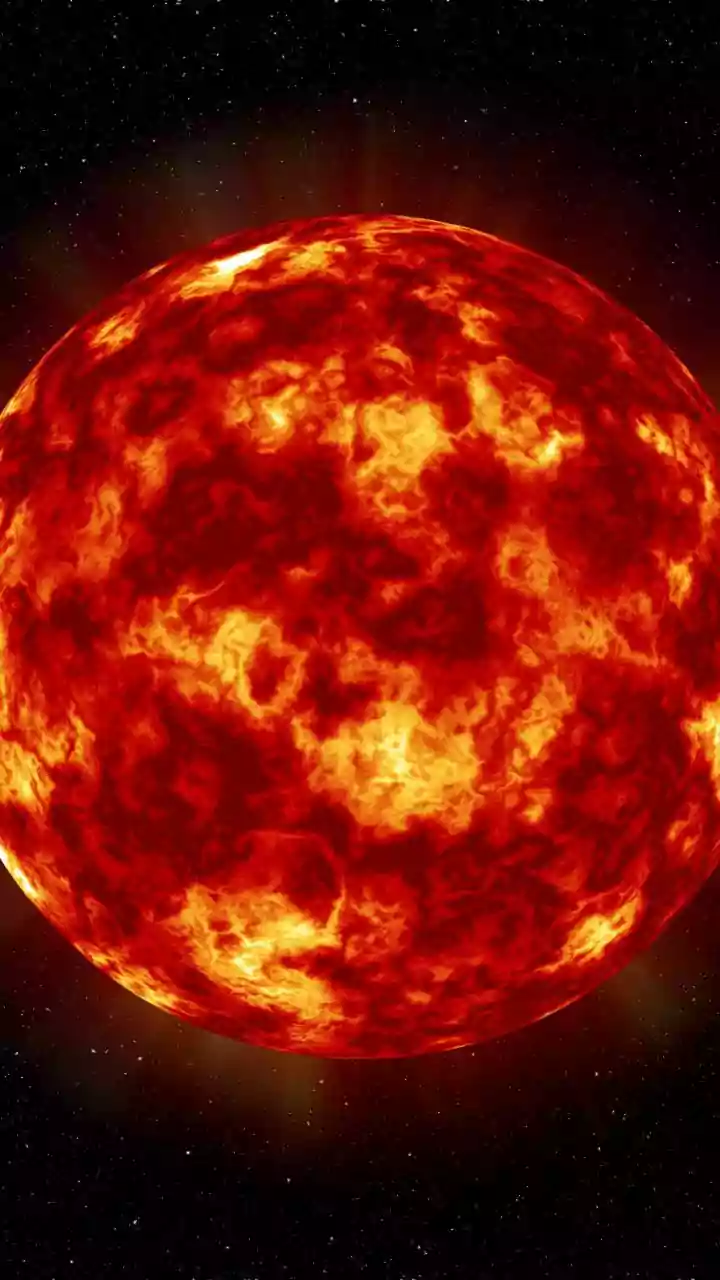
To solve this chemical conundrum, some scientists proposed a radical update to the giant-impact story. What if the collision wasn't a glancing blow, but something far more violent? Research led by Sarah Stewart at UC Davis and Simon Lock at Harvard introduced the concept of a "synestia." In this model, the impact is so energetic that it completely vaporizes both the impactor and a large portion of Earth's mantle, creating a single, massive, rapidly spinning donut of vaporized rock. This structure, the synestia, would have been enormous, with temperatures of thousands of degrees. Within this searing hot cloud, which lasted for perhaps only a few hundred years, the Earth and Moon would have condensed from the same thoroughly mixed batch of material. The Moon would form from vapor raining down inside this structure, naturally explaining why it shares Earth's isotopic fingerprint.
The All-Important Qualification
This brings us to the crucial qualification. The synestia model isn't a complete rejection of the Giant-Impact Hypothesis but a dramatic refinement of it. It is still a story of a massive collision, but one that is more extreme and leads to a different intermediate state—a vaporous synestia instead of a solid debris disk. Furthermore, other very recent high-resolution simulations from NASA and Durham University show another possibility: a Moon-sized body could have been blasted directly into a stable orbit within mere hours of the impact, rather than forming gradually. These new models, which account for factors like the strength of the colliding rocks, don't throw out the idea of an impact; they provide alternative pathways that better explain the Moon's Earth-like composition. So, the headline isn't that the giant impact is dead, but that a simple 'debris-disk' route is no longer the only, or even the best, explanation.