






A Mistake by a Master
Johannes Kepler is a titan of astronomy, the man who figured out that planets move in elliptical orbits. But in May 1607, years before the telescope became a standard scientific instrument, he made a rare blunder. Using a camera obscura—a darkened room
with a small hole that projects an image of the outside world—he cast the Sun’s visage onto a piece of paper. On its bright surface, he saw a small, dark blemish. Convinced he was witnessing the planet Mercury making a rare transit across the face of the Sun, he carefully sketched what he saw. Kepler was one of the most meticulous observers of his era, yet on this occasion, his interpretation was wrong. He wasn't tracking a planet. Unknowingly, he had created one of the earliest detailed drawings of a sunspot. This simple, honest mistake has now become an invaluable piece of data for 21st-century scientists.
From Old Notes to New Insights
For four centuries, Kepler's notes were a historical curiosity. But a recent study, led by an international team of researchers, has dusted off those old sketches and given them a new purpose. By combining Kepler’s drawings with modern astronomical models, scientists were able to work backwards. They calculated the precise orientation of the Sun as it would have appeared from Kepler's location in Prague on that specific day in 1607. This allowed them to determine the exact location, or latitude, of the sunspot on the solar surface. The discovery was more significant than just correcting a historical record; it provided a vital clue about the Sun’s behaviour at a critical moment in its history.
The Sun's Rhythmic Cycle
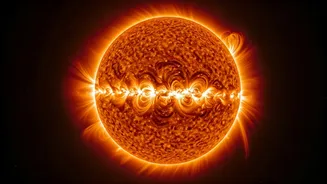
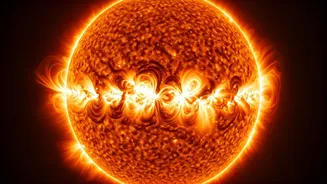
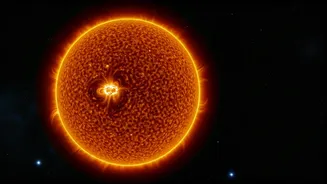
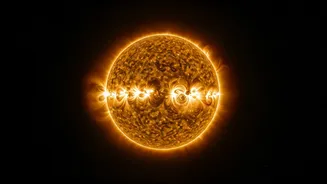
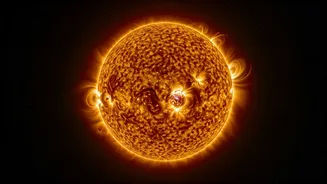
The Sun operates on a roughly 11-year cycle of activity. At the beginning of a cycle, sunspots—cooler, magnetically intense regions on the solar surface—tend to appear at the Sun's higher latitudes. As the cycle progresses, new spots emerge closer and closer to the solar equator. This predictable pattern is known as Spörer's Law. By re-analysing Kepler's drawing, researchers found that the sunspot he saw was at a very low latitude. This told them that the Sun wasn't at the beginning of a new cycle, but at the very end of an old one. It was a crucial data point that helped them anchor our understanding of the Sun’s magnetic rhythm just before a period of profound and mysterious silence.
Solving the Maunder Minimum Mystery
Just a few decades after Kepler made his observation, the Sun entered a strange phase known as the Maunder Minimum. From roughly 1645 to 1715, sunspots almost completely vanished. For 70 years, the Sun was eerily quiet. This 'grand minimum' has long puzzled solar physicists. Did the Sun's magnetic cycle just stop? Or did it continue, but in a much weaker form? Kepler's 1607 observation provides a key piece of the puzzle. It shows that the solar cycle was proceeding normally right before this prolonged quiet spell. This challenges some theories that suggested the cycles were becoming erratically long in the lead-up to the minimum. By confirming a regular rhythm, Kepler's data helps scientists refine their models of what causes the Sun’s magnetic engine to occasionally power down.
Why Historical Data Matters Today
This work is at the heart of space weather science. The Sun's activity, from the number of sunspots to the eruption of solar flares and coronal mass ejections, dictates the conditions in our solar system. Extreme space weather events have the potential to cripple power grids, damage satellites, and disrupt communications on a global scale. To predict these events, we need to understand the Sun's long-term behaviour. Historical records, even accidental ones like Kepler's, are like a time machine. They allow scientists to extend the data record far beyond the modern era of satellite observation, giving them a much deeper understanding of the star we depend on. Kepler's misidentified spot is a perfect example of how the patient work of past observers continues to provide new and unexpected value.