




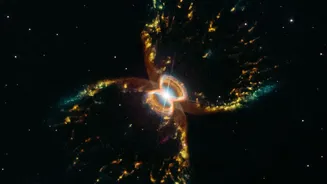
A Cosmic Lion in the Stars
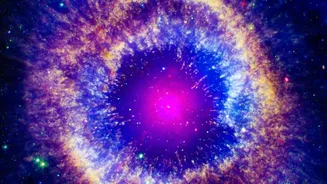
Known formally as NGC 2392, the Lion Nebula gets its nickname from its striking appearance: a central, bright bubble of gas resembling a lion's face, surrounded by a wispy, mane-like structure. This object is a planetary nebula, a glowing shell of gas and
dust cast off by a dying star. For thousands of years, the outer layers of the star have been expanding into space, creating the intricate patterns Webb has now imaged with stunning clarity. While previously observed by the Hubble Space Telescope, Webb's infrared capabilities cut through the cosmic dust to reveal hidden structures and details, providing a much sharper view. The result is a snapshot, freezing a fleeting moment in a process that will see the entire nebula disperse in about 10,000 years — a mere blink in astronomical time.
The Ghost of a Dying Star
At the heart of this celestial artwork lies the culprit: the remnant of a dying star similar in mass to our own Sun. Stars like this don't explode in a violent supernova. Instead, as they exhaust their nuclear fuel, they become unstable, shedding their outer layers into space. What's left behind is an incredibly hot and dense stellar core called a white dwarf. In the Lion Nebula, this white dwarf, which appears like the lion's small button nose, is 'cooking' the surrounding nebula from the inside out. Its intense radiation blasts into the expelled gas and dust, causing it to glow and carving out the cavernous shells and rings we observe.
Two Views Are Better Than One
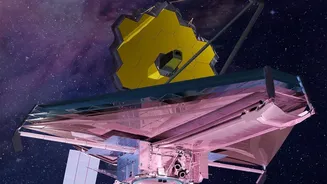
This new image isn't the product of a single observation, but a masterful combination of two of the James Webb Space Telescope's most powerful instruments: the Near-Infrared Camera (NIRCam) and the Mid-Infrared Instrument (MIRI). Think of them as providing two different sets of infrared 'eyes'. NIRCam is Webb's primary imager, capturing shorter infrared wavelengths to see the hotter, ionized gas that forms the lion's 'face'. MIRI, on the other hand, is designed to see longer, mid-infrared wavelengths. This allows it to detect cooler objects, like the intricate filaments of dust that form the 'mane'. By combining the data from both, astronomers can create a complete picture, distinguishing the glowing gas from the surviving clumps of dust and understanding how they interact.
Unlocking Secrets of Stellar Dust
The composite image from NIRCam and MIRI reveals how the central star's ferocious radiation is actively shaping its environment. The expanding bubble of gas that forms the lion's face is destroying some dust in its path. However, the image also highlights dense, compact clumps of dust within the mane that have managed to survive the onslaught. These tougher clumps look like tufts of hair or even comets, and they protect the material lying behind them from the star's radiation. Understanding how and why these structures form and survive is a key area of study for astronomers, as these complex patterns are a common feature in planetary nebulae. Webb's high-resolution observations provide the clearest data yet to help solve this puzzle.
Why a Dying Star Matters
Observing a planetary nebula like the Lion Nebula is more than just capturing a beautiful cosmic scene. It's a glimpse into the final chapter of most stars in the universe, including the eventual fate of our own Sun. More importantly, this process of stellar death is fundamental to cosmic recycling. The dying star enriches the shells of gas and dust it expels with heavier elements like carbon and nitrogen, which were forged inside it. Over thousands of years, this material drifts away and mixes with the interstellar medium, providing the raw ingredients for the next generation of stars and planets. In a very real sense, the elements that make up our world and even our bodies were created and scattered by stars that ended their lives in a similar, spectacular fashion.