






Beyond Hollywood Physics
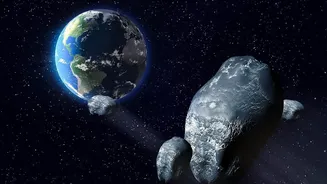
When it comes to planetary defense, simply blowing up a threatening asteroid isn't the preferred, or even most effective, strategy. Many experts believe the goal should be to nudge, not pulverize. A leading concept is using a 'standoff' nuclear detonation.
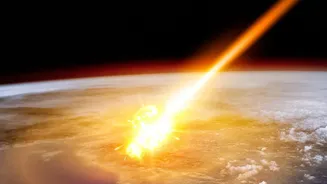
This doesn't mean a direct hit. Instead, a nuclear device would be detonated near the asteroid. The intense burst of X-rays would instantly vaporize a thin layer of the asteroid's surface. That vaporized rock, shooting off into space, would act like a rocket exhaust, creating a gentle but firm push to alter the asteroid's trajectory just enough to miss Earth. The key is giving the asteroid a small push when it's still millions of kilometers away, so that tiny change in velocity results in a huge miss down the line.
The Irregular Shape Problem
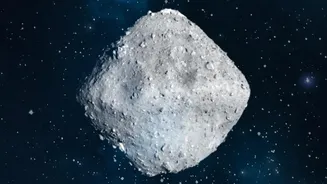
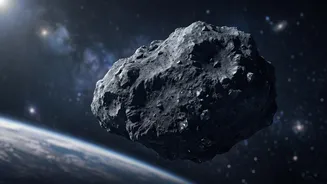
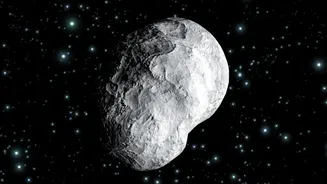
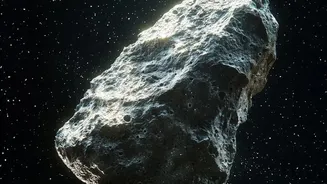
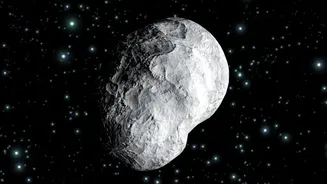
Early models of asteroid deflection often treated these space rocks as simple spheres, which made the calculations much easier. The problem is, most asteroids aren't perfect spheres. They are often lumpy, potato-shaped, or even look like two objects fused together, with uneven surfaces, ridges, and craters. These are often 'rubble piles'—collections of rock and dust held together by their own weak gravity. New simulations by researchers at Sandia National Laboratories sought to understand how this irregularity affects a deflection attempt. What they found was surprising in its significance: an asteroid’s shape is not a minor detail, but a critical factor in the success of a mission.
A Fivefold Difference
Using sophisticated new computer models that are over 1,600 times faster than previous methods, Sandia physicist Nathan Moore and his team ran simulations on realistic asteroid shapes like Bennu and Itokawa. They simulated an X-ray blast hitting the asteroids from different angles. The results were dramatic. For one simulated asteroid, hitting it from one direction produced a change in velocity nearly five times greater than hitting it from another side. For a different asteroid, the resulting change in its spin varied by a factor of 17. 'We expected aim to matter,' Moore stated in a recent release. 'What surprised us was how much'.
Why Aim Is Everything
The massive variance comes down to topography. A blast that hits a relatively flat, broad surface will push the asteroid cleanly. But if the same blast hits a sloped area or a ridge, the resulting vapor jet will be angled, pushing the asteroid inefficiently or sending it into an unpredictable spin. The simulations create a 'heat map' of the surface to calculate how the vaporized material will push the asteroid. It's the difference between pushing a box squarely in the center versus pushing it on a corner. Pushing the corner might waste a lot of energy just making the box spin. For an asteroid, an uncontrolled spin could complicate followup tracking and make it harder to predict its new path.
The Future of Planetary Defense
This research provides invaluable data for future planetary defense planning. It confirms that if we ever need to deflect an asteroid, a 'one-'size-'fits-'all'' approach is dangerously simplistic. Any potential mission would first need to get a detailed '3D model of the target asteroid to identify the optimal place to aim. This work builds on the real-'world success of NASA’s DART mission, which proved a kinetic impactor could change an asteroid's orbit, and complements the ongoing research by Europe's Hera mission, which is studying the aftermath. While the Sandia simulations focused on a nuclear approach, the core finding—that shape and targeting are critical—is a lesson for all deflection methods. The main goal remains to push the asteroid without shattering it into multiple dangerous fragments, a detail the models are still working to fully predict.