


The Galactic Centerpiece
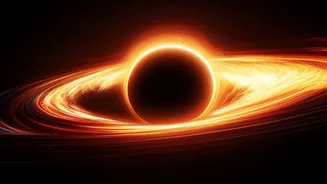
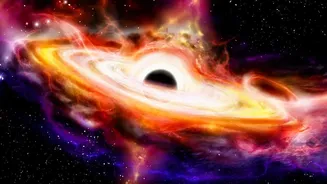
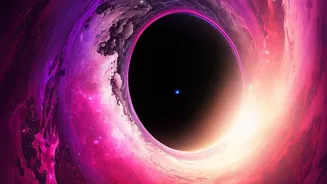
In the grand architecture of the cosmos, supermassive black holes are considered the ultimate centrepieces. Weighing millions or even billions of times more than our sun, these gravitational behemoths are found at the core of nearly every large galaxy,
including our own Milky Way. Their immense gravity orchestrates the movement of stars and gas around them, making them the stable, predictable anchors of their galactic homes. This assumption has been fundamental to our understanding of how galaxies form and evolve. But the universe is rarely so tidy, and recent discoveries have revealed a much more dynamic and chaotic picture, one where these giants are not always where we expect them to be.
An Unexpected Flash in the Dark
The key to finding a wandering black hole lies in catching it in the act of doing something dramatic. By themselves, black holes are invisible. But when a star strays too close, the black hole's gravity rips it to shreds in a violent event called a tidal disruption event (TDE). This process heats up the stellar debris, creating an incredibly bright flare of light that can briefly outshine the entire host galaxy. In November 2025, the Zwicky Transient Facility (ZTF) spotted just such a flare, but in a very unusual location: the outskirts of a galaxy 750 million light-years away, over 30,000 light-years from its core. This was the first clue that something strange was afoot.
Reading the Clues with Swift
To understand the flare, astronomers turned to multiple observatories, with a crucial role played by NASA's Neil Gehrels Swift Observatory. While ground-based telescopes confirmed the flare had the hallmarks of a star being shredded, Swift's ability to observe in ultraviolet and X-ray wavelengths provided the missing pieces of the puzzle. The intense heat from a TDE causes it to glow brightly in these high-energy parts of the spectrum. Swift's Ultraviolet/Optical Telescope measured the temperature of the glowing stellar gas at around 30,000 degrees Celsius. This high-energy signature, coming from a location with no business hosting a supermassive black hole, was the 'smoking gun'. It confirmed they were seeing an otherwise dormant, off-centre black hole light up as it devoured a meal.
A Tale of Cosmic Collisions
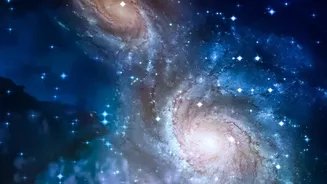
So why would a supermassive black hole be wandering in the first place? The leading theory points to a violent past involving galaxy mergers. When two galaxies collide, their central black holes begin to orbit each other, a process governed by a force called dynamical friction, where they lose energy by gravitationally disturbing the surrounding stars. They spiral inward, eventually merging into a single, larger black hole. This process is how the largest black holes in the universe are thought to grow. However, this cosmic dance is rarely perfect. The chaotic gravitational interactions during a merger can destabilize everything, including the central black hole itself.
The Gravitational 'Kick'
When two black holes merge, they unleash a colossal amount of energy in the form of gravitational waves—ripples in the fabric of spacetime. If the two merging black holes have unequal masses or spins, these gravitational waves can be launched more forcefully in one direction than another. Due to the law of conservation of momentum, this creates a powerful 'kick' that sends the newly formed, larger black hole recoiling in the opposite direction at incredible speeds. This kick can be strong enough to displace the black hole from the galactic centre, or in extreme cases, eject it from the galaxy entirely, sending it hurtling through intergalactic space.
Why Wandering Black Holes Matter
Finding these wandering giants does more than just satisfy our curiosity about cosmic oddities. It provides crucial evidence that our theories about galaxy evolution are on the right track. Each off-centre black hole is a fossil record of a past galactic merger, giving us a way to study the violent history of the universe. Furthermore, these discoveries challenge our models of galaxy growth, as a black hole that has been kicked from the dense galactic core can no longer feed on gas and influence star formation in the same way. By learning how to 'read' the signs of these displaced behemoths, as demonstrated by the Swift discovery, we open a new window into the dynamic and ever-changing lives of galaxies.