




How Has Expansion Changed the Bloc?
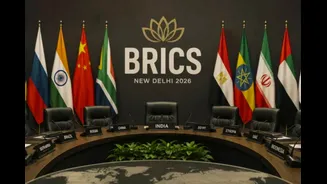
The BRICS of 2026 is a far cry from its original four members. With the addition of Egypt, Ethiopia, Iran, Indonesia, Saudi Arabia, and the UAE, the group's economic weight has grown immensely. This expansion brings together major energy producers and key
consumer hubs, accounting for nearly 40% of global GDP on a purchasing power parity basis. The goal, under India's 2026 chairship, is to leverage this scale for practical cooperation. However, a larger membership also introduces greater complexity. The bloc now includes countries with vastly different political systems and, at times, conflicting regional interests, such as the strategic competition between India and China or tensions between Iran and other Gulf states. The key challenge moving forward is managing this diversity to create coherent policies rather than letting internal frictions stall progress.
Is the 'De-Dollarization' Dream Realistic?
Talk of a BRICS currency to challenge the US dollar often grabs headlines, but the reality on the ground in 2026 is more nuanced. Officials, particularly from India, have clarified that the immediate goal is not to create a common currency but to promote the use of national currencies in bilateral trade. This strategy aims to reduce transaction costs and shield member economies from the volatility of the dollar and US monetary policy. While progress is being made with payment systems like BRICS Pay, data shows the dollar's dominance remains firm. The US dollar still accounts for over half of global foreign exchange reserves and trade invoicing. Experts suggest that rather than a dramatic overthrow, we are seeing a gradual erosion at the edges as countries build alternative financial infrastructure as a form of economic self-defence.
What Is the New Development Bank Actually Doing?
The New Development Bank (NDB), often called the 'BRICS Bank', is one of the bloc's most concrete achievements. Established as an alternative to the World Bank and IMF, the NDB finances infrastructure and sustainable development projects in member countries. By late 2025, it had already approved nearly $43 billion for projects spanning clean energy, transport, and water sanitation. A key feature is its increasing focus on lending in local currencies, which helps insulate projects from exchange rate risks. The NDB aims to have 30% of its financing in local currencies by the end of 2026. However, the NDB is still a much smaller player than the Bretton Woods institutions and remains partially dependent on international capital markets for its own funding.
Can the Members Overcome Their Differences?
This remains the central question for BRICS. The bloc's unity is tested by significant internal rivalries and divergent foreign policies. For example, India's longstanding strategic competition with China is a major fault line. Similarly, Russia and Iran's adversarial relationship with the West contrasts with the more balanced approaches of members like India, Brazil, and the UAE. Geopolitical events, such as the conflict in the Middle East, create further tensions between members like Iran and its neighbours. India's role as the 2026 chair has been to steer the agenda toward practical economic cooperation and development, seeking to build consensus on issues like trade, technology, and health rather than getting bogged down in geopolitical disputes where agreement is difficult.
What Does This Mean for India?
For India, hosting the 2026 BRICS summit is a strategic opportunity. New Delhi aims to position itself as a leading voice for the Global South, pushing an agenda focused on tangible outcomes rather than just political declarations. India's theme for its chairship — “Building for Resilience, Innovation, Cooperation, and Sustainability” — reflects a focus on strengthening supply chains, promoting digital innovation, and tackling climate change. Strategically, India plays a crucial balancing act. It uses the platform to advance its economic interests and champion the cause of developing nations while preventing the bloc from becoming an overtly anti-Western coalition dominated by China. By driving cooperation on its own terms, India seeks to enhance its strategic autonomy and ensure BRICS serves its developmental goals.