



A Glimpse into the Cosmic Dawn
The galaxy in question, known as J0148-4214, is astonishingly far away. The light from this system has traveled for over 12.5 billion years to reach us, meaning we are seeing it as it existed just 1.2 billion years after the Big Bang. This makes it a priceless
relic from the universe's infancy. Finding anything in this era is a challenge, but finding such a complex and active system is a major breakthrough. An international team led by the Max Planck Institute for Extraterrestrial Physics used the JWST to make the discovery, which provides the first direct evidence of a black hole triplet in the distant universe.
How Webb Uncovered the Giants
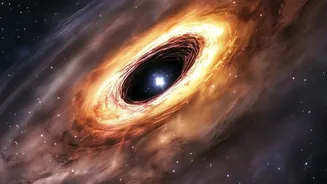
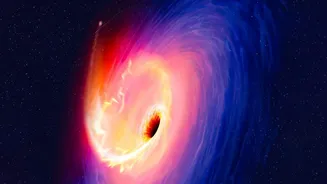
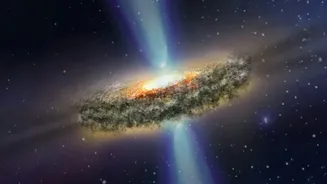
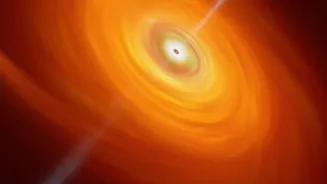
Supermassive black holes themselves are invisible, as their immense gravity traps even light. So, how did astronomers find them? The key was to look for their 'signatures'. As gas and dust are pulled towards a black hole, they form a swirling, superheated structure called an accretion disk. This disk glows intensely, and the material moving at incredible speeds within it emits a characteristic spectrum of light. The team used the Webb telescope’s Near-Infrared Spectrograph (NIRSpec) to analyze the light from J0148-4214. They detected the tell-tale signs of rapidly moving hydrogen gas—too fast to be explained by anything other than the gravitational pull of multiple supermassive black holes. The data was so detailed it allowed them to distinguish three separate sources of this activity.
A Trio of Cosmic Monsters
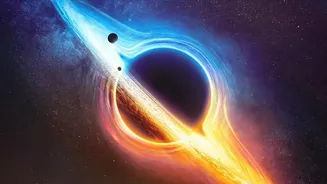
The analysis revealed a fascinating and lopsided family of black holes. Two are located close to the galaxy's center, separated by a mere 620 light-years—a tiny distance in cosmic terms. One of these is a behemoth, weighing in at around 80 million times the mass of our sun. Its close companion is a relative lightweight at just 600,000 solar masses. Intriguingly, the smaller black hole appears to be feeding more aggressively than its giant neighbor, growing at a rate that pushes the limits of theoretical models. A third black hole, with a mass of about 2 million suns, lurks further out in the galaxy, roughly 5,500 light-years from the central pair.
Rewriting the History of Galaxies
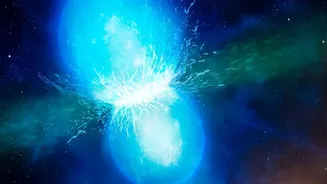
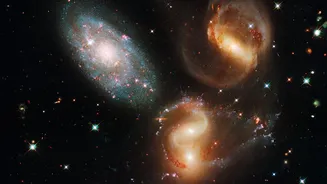
This discovery offers a potential solution to a major puzzle in astronomy: how did supermassive black holes get so big, so fast in the early universe? While black holes grow by consuming gas, that process alone might not be sufficient to explain the behemoths seen in the cosmic dawn. The J0148-4214 system provides compelling evidence for another growth method: galaxy mergers. The presence of three black holes strongly suggests that we are witnessing the result of at least two galaxies colliding. As galaxies merge, their central black holes sink towards the new center and eventually combine, growing rapidly in the process. This system captures that messy, chaotic, and crucial stage of galaxy evolution in action.