






More Than Just a Handle
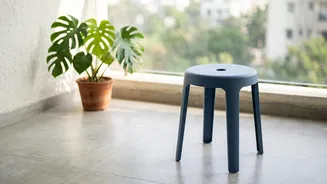
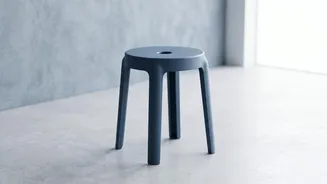
The most obvious reason for the hole is that it serves as a convenient handle. Instead of gripping the wide seat, you can simply slip your fingers through the opening to pick it up and move it around. This is especially useful when you're carrying one
in each hand or need to quickly rearrange seating. The central location of the grip provides a balanced and controlled hold, making it easier than grabbing a corner. While this is a clear benefit, it is far from the only reason. The true genius of the design reveals itself when you consider the challenges of stacking and durability.
The Physics of Stacking
Plastic stools are designed to be stacked high to save space, a familiar sight in homes, shops, and event venues. If the stools had a solid, flat surface, stacking them would create a significant problem: air pressure. When one stool is placed snugly on top of another, it traps a pocket of air. Trying to pull them apart would create a vacuum, making them incredibly difficult to separate. It’s the same principle that makes it hard to pull two wet glass plates apart. The hole allows air to flow freely between the stacked stools, equalising the pressure and ensuring they can be unstacked with ease. This simple feature is crucial for anyone who has ever had to set up or pack away dozens of chairs.
A Question of Strength and Structure
It may seem counterintuitive, but removing material from the centre of the stool can actually enhance its structural integrity. A key reason the hole exists is to prevent the stool from cracking under pressure. When a person sits down, their weight is distributed across the seat. A circular hole, as opposed to a square or angular one, helps to spread this force evenly across the surface. Shapes with sharp corners create points of concentrated stress, which are prone to cracking over time. By using a rounded opening, manufacturers avoid these weak points, making the stool more durable and resilient to the wear and tear of daily use.
Smart Manufacturing
The hole also plays a role in the manufacturing process itself. Most plastic stools are made using injection moulding, where molten plastic is injected into a mould under high pressure. The hole isn't just an absence of material; it's a feature of the mould. Including it can help ensure the plastic flows and cools evenly, reducing the risk of defects. Furthermore, it subtly reduces the amount of raw material needed for each stool. While the saving per stool is tiny, it adds up to a significant cost and material reduction when multiplied over millions of units produced annually. It's a small detail that contributes to the affordability and mass availability of these ubiquitous items.
The ‘Latest Development’ is Curiosity
So, what is the 'latest development' regarding this decades-old design? The development isn't in the stool itself, but in our collective rediscovery of its cleverness. The question of the hole has become a recurring viral topic on social media platforms. Every few months, a post explaining the physics of the stool will capture the internet's attention, sparking a wave of 'mind-blown' reactions from people who are noticing this piece of everyday engineering for the first time. This repeated cycle of public curiosity is the real story here. It highlights how much intelligent design is hidden in plain sight, and how a simple question can reveal the thoughtful engineering behind the most mundane objects we use every day.