







A Curious Discovery on Mount Sharp
While ascending Mount Sharp, the towering 5-kilometre-high peak inside Gale Crater, the Curiosity rover spotted something unusual. Dotted across the bedrock were several small, shallow pits. The discovery was made in an area informally named Valle Grande.
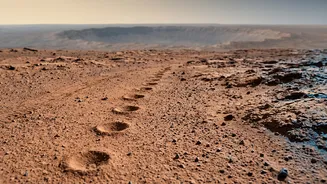
Holes are not uncommon on Mars, a planet constantly bombarded by meteorites over billions of years. However, these particular depressions immediately stood out to the mission's science team as something they had not seen before. One of the pits, measuring about a centimetre across, was photographed in detail on August 19, revealing its peculiar characteristics.
What Makes These Holes So Strange?
The mystery lies in how these holes differ from typical Martian geology. Usually, small pits in Martian rock are formed when harder pebbles or mineral nodules, embedded in softer surrounding rock, eventually weather away and fall out. This process leaves behind a cavity where the object once was. But the holes found by Curiosity are different. They are unusually broad and shallow, and crucially, there are no obvious pebbles or nodules nearby that look as though they once occupied these spaces. This lack of a clear cause has prompted scientists to take a much closer look, turning a routine observation into a genuine scientific puzzle.
Searching for a Geological Explanation
With the most common explanation not fitting the evidence, scientists are now exploring other possibilities. The prevailing belief is that the answer is still geological, rather than anything more exotic. NASA is not suggesting the holes have a biological origin. Instead, the team is investigating unfamiliar erosion processes or unique properties of the rock in this specific region of Mount Sharp. To solve the riddle, the rover is using its advanced toolkit. The Mars Hand Lens Imager (MAHLI) on its robotic arm has taken close-up shots, while the Mastcam has captured overlapping stereo images. By combining these images, scientists can create detailed 3D models of the pits to analyze their shape and depth, hoping to work backwards to uncover how they were formed.
Context Is Everything: A Changing Landscape
The location of these holes is significant. Curiosity is currently exploring the sulfate-rich layers of Mount Sharp, an area that holds clues to one of the last wet periods on Mars, roughly three billion years ago. The rover has recently passed through terrain with other strange features, including a vast expanse of honeycomb-like polygonal fractures that may have formed as ancient mud dried out. The rock layers themselves are also changing rapidly as the rover ascends, with different textures and resistance to erosion. These holes are another piece of the complex history of water and climate change on the Red Planet, a story that Curiosity was sent to read in the rocks of Gale Crater.
What Happens Next in This Martian Mystery?
The investigation is ongoing. Further analysis of the chemical composition of the rocks in Valle Grande, which Curiosity has already sampled, will take time. Scientists will use the 3D models of the holes to test various formation theories. Was it a specific type of mineral deposit that dissolved? Or perhaps a phenomenon related to the way wet sediments dried and compacted billions of years ago? Each new, unexplained feature provides a valuable opportunity to refine our understanding of Mars's geological processes. It’s a reminder that even after years of exploration, the planet still holds secrets. For now, the strange holes remain an open case file for the NASA team, a small but compelling mystery waiting to be solved millions of kilometres from Earth.