



A Tale of Two Planetary Fates
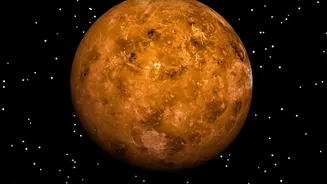
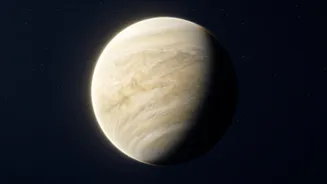
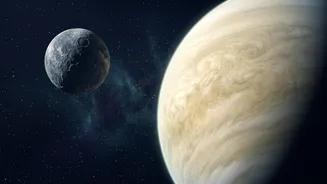
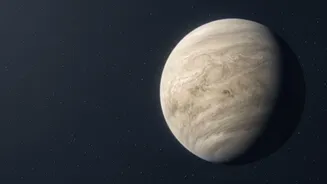
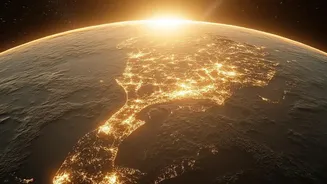
Imagine two sibling planets, born from the same cosmic dust, nearly identical in size and mass. One, Earth, becomes a vibrant world with a large, stable moon. The other, Venus, evolves into a hellscape with a thick, toxic atmosphere and no moon at all.
For decades, scientists have puzzled over this stark difference. Previous theories suggested a massive impact destroyed a Venusian moon or that one simply never formed. But recent research offers a more elegant, and perhaps more brutal, explanation that doesn't require a separate catastrophe. The culprit, it seems, might be Venus itself.
The Physics of a Planetary Tug-of-War
The relationship between a planet and its moon is a delicate dance of gravity and energy. Earth's relatively fast 24-hour rotation transfers energy to our Moon, causing it to slowly drift away from us at a rate of about four centimetres per year. This outward migration is a direct consequence of our planet spinning faster than the Moon orbits it. Venus, however, is the complete opposite. It has an incredibly sluggish rotation, taking 243 Earth days to complete a single spin. New simulations by astrophysicist Stephen Kane from the University of California, Riverside, show this slowness would have a fatal effect on any orbiting satellite.
Simulating a Moon's Demise
To test the hypothesis, Kane’s team developed computer models to simulate the gravitational interactions over billions of years. They first tested the model on the Earth-Moon system, successfully reproducing its current, well-understood evolution. Then, they turned their attention to Venus, running scenarios with various hypothetical moons and different initial rotation speeds for the planet. The results were shockingly consistent. Unless early Venus was spinning much faster than previously thought (with a day shorter than about 12-16 hours), any moon it had was doomed. Instead of drifting away like ours, the simulations showed a Venusian moon would be pulled inexorably inward.
A Fiery End and a Reshaped World
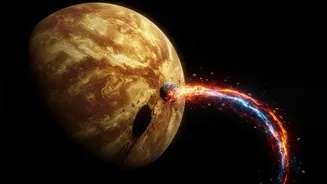
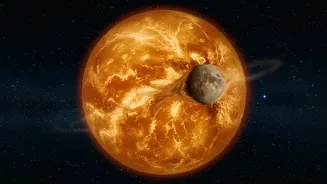
In the simulations, the slow rotation of Venus caused the hypothetical moon to lose orbital energy, spiraling closer and closer to the planet. Eventually, it would have reached the Roche limit—a point where the planet's gravitational pull is so much stronger on the near side of the moon than the far side that it tears the moon apart. The debris would then rain down, crashing into Venus in a cataclysmic event. Such a massive collision would have delivered an enormous amount of energy and momentum to the planet. This impact could have profoundly altered Venus's geology, climate, and even its rotation, potentially helping to explain why the planet is the strange, inhospitable world we see today.
The Search for Ancient Evidence
While this theory provides a compelling narrative, it's important to note that it describes a possible history, not definitive proof that Venus had a moon. Finding direct physical evidence of such a long-ago collision is incredibly difficult. A massive resurfacing event about a billion years ago is believed to have wiped out most of Venus's older geological history, essentially paving over any ancient craters. However, clues might remain. Scientists propose looking for chemical traces of lunar debris in Venus's atmosphere or searching for unusual structures deep beneath its surface, similar to how seismic data on Earth may point to remnants of the giant impact that formed our own Moon. Future missions, like NASA's DAVINCI, could provide the atmospheric measurements needed to test this idea.