







The Apex Predator's Dilemma
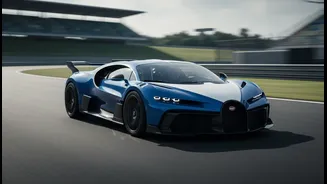
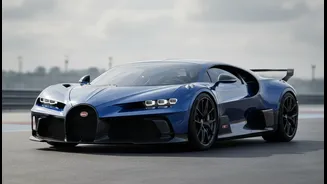
When Bugatti unveiled the Bolide, it was presented as the ultimate expression of its legendary W16 engine, wrapped in the lightest possible chassis for pure track dominance. With 1,600 horsepower, a dry weight of just 1,450 kg, and aerodynamics that generate
nearly three tonnes of downforce, the car was designed to be faster around a circuit than a Formula 1 car in some respects. This created a unique challenge. The very extremity that made the Bolide a legend also made it intimidating for all but the most seasoned professional drivers. For the 40 ultra-wealthy clients who purchased this machine, the question became: how do you actually experience the full potential of a car that operates at such a high level?
Engineering a Touch of Civility
The solution was not to blunt the Bolide's edge but to make it more approachable. Bugatti’s engineers embarked on an intensive development program, refining the car’s handling characteristics. While the factory Bolide remains a track-only machine, the concept of a 'softer' setup has been most prominently showcased by British engineering firm Lanzante, which recently converted a Bolide for street-legal use. This conversion involved softening the track-tuned suspension to handle the imperfections of public roads. Even within Bugatti's own track development, making the car more manageable was a key goal. Test driver Andy Wallace noted that despite its immense capabilities, the Bolide was engineered to be remarkably easy to drive at its limit, a characteristic achieved through meticulous tuning of its advanced push-rod suspension and active safety systems.
Redefining 'Usable' on the Track
For a hypercar like the Bolide, 'usability' isn't about a comfortable ride to the shops. It’s about giving the driver the confidence to explore the car's performance. An overly stiff, unforgiving setup can be skittish and unpredictable, especially on a circuit with bumps and aggressive kerbs. By slightly softening the suspension, engineers make the car more compliant and predictable. This allows the driver to feel more connected and in control, ultimately enabling them to push harder and achieve faster lap times. Bugatti's own development focused on accessibility, ensuring the Bolide could be enjoyed by drivers without professional race experience. A customer who took his car to the Circuit of the Americas noted that, after training, the Bolide was "incredibly easy to handle" and its performance was "completely manageable," even in the rain.
Preserving the Unfiltered Theatre
Crucially, these adjustments don't dilute the core experience. The 'hypercar theatre' of the Bolide remains fully intact. The heart of the machine is its roaring 8.0-litre quad-turbocharged W16 engine, which has been tuned for an even more visceral soundtrack. The savage acceleration, capable of pinning you to your seat, is unchanged. The extreme aerodynamic grip, which can generate lateral forces of up to 2.5 G in corners, still delivers a mind-bending experience. Features like air conditioning and power steering were included from the start, proving that even in its most extreme form, Bugatti never completely forsook refinement. The suspension tweak is a subtle refinement, not a fundamental change. It ensures the driver is focused on the symphony of the engine and the thrill of the speed, rather than wrestling with a car that is needlessly difficult to control.