

A Cosmic Crime Scene
Astronomers have long been puzzled by a strange feature of our galaxy: its stellar halo. This is a vast, sparse cloud of ancient stars that surrounds the main galactic disc. Data from the European Space Agency's Gaia mission showed that while stars in the disc orbit
the galactic center at a brisk 220 kilometers per second, the stars in the halo barely move, rotating at a comparatively sluggish pace. This discrepancy was a major mystery. To solve it, astronomers at Durham University turned to powerful supercomputer simulations to piece together the clues left behind in the stars. Their findings, presented at the Royal Astronomical Society's National Astronomy Meeting, point to a single, cataclysmic event that reshaped our galaxy's entire existence.
The Gaia Sausage Collision
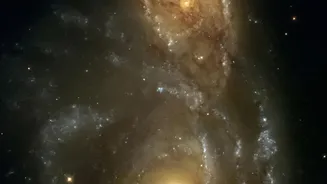
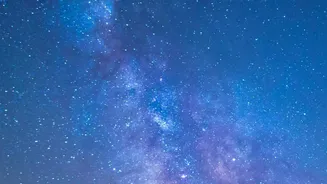
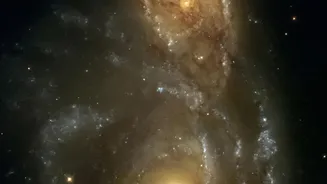
The culprit was a dwarf galaxy known to astronomers as Gaia-Sausage-Enceladus. This appropriately named galaxy, whose debris is stretched out in a sausage-like shape, slammed head-on into the young Milky Way between 10 and 11 billion years ago. While the Milky Way was the clear victor, tearing the smaller galaxy to shreds and absorbing its stars, the impact was monumental. It was the last major merger in our galaxy's history and its most defining event, fundamentally changing its structure. The collision scattered billions of the intruder's stars into the elongated orbits that now make up a significant part of the stellar halo we observe today.
Flipping the Galactic Disc
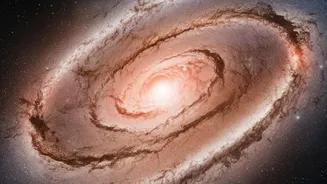
The new research shows this collision did more than just add stars to our halo; it likely sent the entire Milky Way for a spin. According to the supercomputer simulations, a head-on collision of this magnitude would have unleashed such chaos that it caused the entire flat disc of our galaxy to flip by more than 90 degrees. This slow-motion somersault, which would have taken hundreds of millions of years, reoriented our galaxy into the position it holds today. The models showed that galaxies that experienced both a major head-on merger and a subsequent disc flip ended up with the same kind of slow-moving stellar halo that has puzzled scientists for so long. This finding provides a compelling explanation for the long-standing mystery.
A New Galactic Biography
This discovery effectively rewrites a key chapter of our galaxy's biography. The idea that our entire galaxy was knocked onto its side changes our perspective on its evolution. It means that for billions of years, the stars in the Milky Way, including the precursors to our own Sun, traveled on completely different paths through the cosmos than they do now. This violent past helps explain the formation of the galaxy's central bulge and the mixed-up nature of its halo. It confirms that galaxies are not static islands of stars but dynamic, evolving structures shaped by dramatic and violent encounters. Understanding this flip also helps astronomers reconstruct the complex history of the Milky Way, using the current motions of stars as a guide to its turbulent youth.