




The Universe’s Phantom Messengers
They are called neutrinos, and they live up to their ghostly reputation. These fundamental particles have almost no mass and no electric charge, meaning they barely interact with the world around them. A neutrino can fly through a planet, a star, or a person
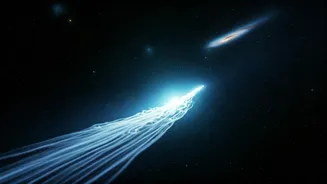
without leaving a trace. While this makes them incredibly difficult to detect, it also turns them into perfect cosmic messengers. Unlike light or charged particles, which can be blocked by dust or deflected by magnetic fields, neutrinos travel in a straight line from their birthplace, carrying unaltered information across billions of light-years. Scientists capture them using colossal detectors, like the IceCube Neutrino Observatory, which uses a cubic kilometre of pristine Antarctic ice. When a neutrino, on the rarest of occasions, strikes an atom in the ice, it produces a faint flash of light, a tiny breadcrumb leading back to some of the most violent events in the cosmos.
A Cosmic Case of Missing Sources
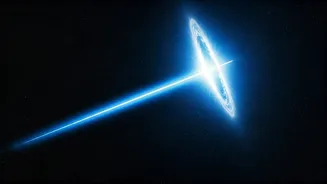
For years, physicists have been detecting high-energy neutrinos arriving from deep space, but they couldn't definitively say where they came from. The main suspects were extreme objects like blazars—supermassive black holes at the centres of galaxies that shoot out powerful jets of matter and energy directly toward Earth. In 2018, scientists successfully traced one neutrino back to a flaring blazar, confirming they are at least one source. However, these known sources didn't seem to account for the total number of high-energy neutrinos IceCube was detecting. There was a gap in the story; a significant portion of these particles seemed to be coming from directions in the sky with no obvious powerful source. The universe, it seemed, had a secret neutrino factory hidden somewhere in the dark.
A Signal from the Shadows
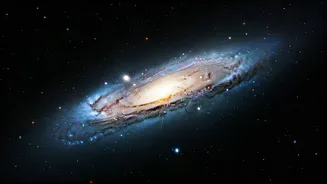
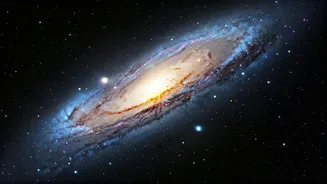
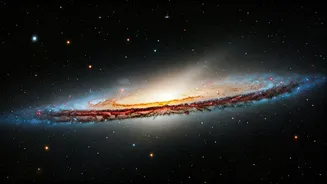
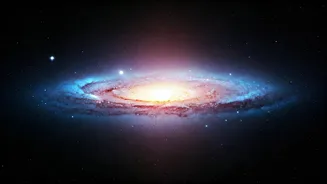
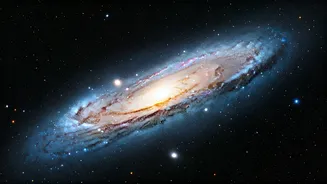
The latest breakthrough comes from a single high-energy neutrino that hit the Antarctic ice back in 2021. After the alert from IceCube, astronomers around the world scoured the patch of sky the particle came from, but found nothing—no exploding star, no flickering black hole. The mystery deepened until a team decided to look for something else: not a bright, violent object, but a quiet, hidden one. Using telescopes that detect longer wavelengths of light, they peered through the cosmic dust and found a candidate: a distant galaxy nicknamed the “Shadow Blaster.” Located 11 billion light-years away, this galaxy is churning out new stars at a furious rate but is so choked with dust that it’s nearly invisible to traditional telescopes. This discovery provides the first strong evidence linking a high-energy neutrino to an individual star-forming galaxy.
Why This Changes Everything
If confirmed, this finding could reshape our understanding of the high-energy universe. It suggests that the most dramatic objects, like blazars, might not be the only major source of cosmic neutrinos. Instead, countless dusty, star-forming galaxies across the universe could be collectively producing a substantial portion of these ghost particles. The theory is that the dense environments within these stellar nurseries act as natural particle accelerators, creating cosmic rays that then interact with gas and radiation to produce neutrinos. This opens up an entirely new type of object to study and could help solve the long-standing mystery of where the universe’s most energetic cosmic rays originate, as neutrinos are thought to be produced alongside them. It’s a powerful demonstration of “multi-messenger astronomy,” where combining information from different cosmic messengers—in this case, particles and light—helps us see what would otherwise remain hidden.