


Understanding SMOPS-2026
The International Conference on Spacecraft Mission Operations, or SMOPS-2026, held in Bengaluru, is a pivotal event bringing together global space agencies, industry leaders, and academia. Organized by ISRO, the Astronautical Society of India (ASI), and the International Academy
of Astronautics (IAA), this year's conference focuses on smart and sustainable space mission management. A key theme dominating the discussions is the integration of Artificial Intelligence and Machine Learning (AI/ML) into spacecraft operations to create more autonomous and efficient systems. As ISRO Chairman Dr. V. Narayanan noted, what was theoretical a decade ago is now a necessity for modern space missions.
The Achilles' Heel of Space Assets
For decades, satellites have been reliant on a continuous link with ground stations on Earth. These stations are responsible for everything: monitoring a satellite's health, sending commands for orbital adjustments, managing data, and ensuring the mission runs smoothly. However, this dependence creates a significant vulnerability. Ground stations are fixed, physical targets that can be disabled through military action, cyberattacks, or even natural disasters. Losing contact with a satellite, even temporarily, can compromise its mission, whether it's for navigation, communication, or national security surveillance. This reliance on ground control is increasingly seen as a strategic liability in an era of growing geopolitical tensions.
How AI Is Changing the Game
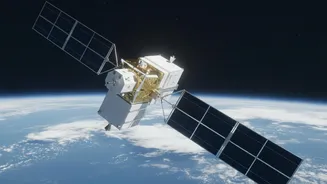
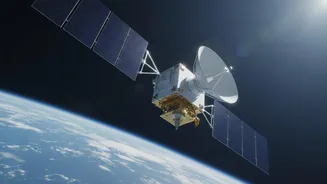
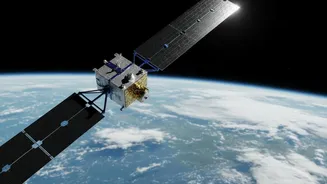
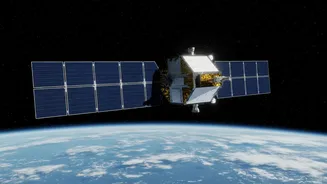
The discussions at SMOPS-2026 revolve around a paradigm shift: embedding AI directly onto the satellites. Instead of waiting for instructions from Earth, these AI-powered spacecraft can make critical decisions autonomously. This onboard intelligence can handle a range of tasks that were previously managed by ground crews. For instance, AI algorithms can perform real-time health monitoring and diagnostics, detecting potential system failures before they become critical. This move towards onboard autonomy drastically reduces the time between detecting a problem and implementing a solution, from minutes or hours to mere seconds.
Key Capabilities of an AI-Led Satellite
An autonomous satellite offers several transformative capabilities. One of the most critical is collision avoidance. With millions of pieces of space debris orbiting Earth, the risk of a catastrophic impact is a constant threat. AI can process tracking data far faster than humans, allowing a satellite to automatically adjust its orbit to dodge debris. Another capability is autonomous tasking and navigation. For surveillance satellites, AI can identify objects or areas of interest without human prompting, a system NASA is already experimenting with. Furthermore, in the face of electronic warfare tactics like signal jamming, an AI-powered satellite can intelligently reroute its communications or even identify the source of the interference, ensuring mission continuity. This enhances the survivability and resilience of India's assets in space.
The Strategic Advantage for India
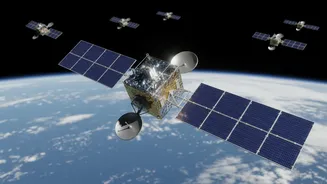
For India, developing autonomous satellite capabilities is a major step towards strategic autonomy, a cornerstone of the 'Atmanirbhar Bharat' vision. A less fragile satellite network means more reliable services for military and civilian users alike, from the NavIC positioning system to critical intelligence, surveillance, and reconnaissance (ISR) operations. Start-ups are already working under the government's Innovations for Defence Excellence (iDEX) initiative to build constellations of AI-powered spy satellites that can swarm and self-task. By reducing dependence on ground control, India ensures its 'eyes and ears' in the sky can function effectively under any circumstances, solidifying its position as a formidable space power.