




A Young Star System Next Door
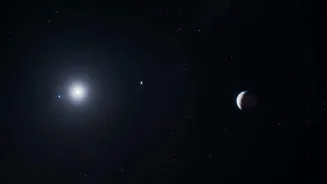
The Beta Pictoris system is a cosmic infant, only about 23 million years old—a fraction of our own solar system's 4.6 billion years. Located in the constellation Pictor, it's one of the most studied planetary systems outside our own. At its center is a star
brighter and more massive than our sun, surrounded by a sprawling disk of dust and debris, the raw material for planet formation. Orbiting within this disk is Beta Pictoris b, a massive 'super-Jupiter' that is between 9 and 13 times the mass of our own Jupiter. Because the system is so young, observing it is like looking through a time machine, giving scientists a rare glimpse into the chaotic and dynamic processes that build planetary systems, possibly including ones like our own.
Decoding a Planetary Broadcast
The 'signal' from Beta Pictoris b isn't a message; it's a radio broadcast powered by the planet itself. Recently, astronomers using the MeerKAT radio telescope array in South Africa detected repeating radio bursts coming directly from the exoplanet. This is the first time a radio emission has been unambiguously traced to a planet outside our solar system. The signal is generated by a process known as electron cyclotron maser instability, the same mechanism that creates the brilliant auroras on planets in our own solar system, including Earth's Northern and Southern Lights. Essentially, charged particles interact with the planet's magnetic field and atmosphere, producing powerful radio waves that we can detect from light-years away.
Why It's a Powerful and Natural Signal
The signal is powerful for two main reasons: the planet's massive size and its strong magnetic field. The radio emissions allowed scientists to calculate the strength of Beta Pictoris b's magnetic field for the first time, estimating it to be thousands of times stronger than Earth's. This powerful magnetic field acts like a giant cosmic generator, creating the intense radio bursts. We know the signal is natural because it perfectly matches the signature of auroral radio emissions seen on Jupiter and other gas giants. Furthermore, the host star, Beta Pictoris, is known to be 'magnetically quiet', meaning the signal couldn't have come from stellar activity, which helped astronomers isolate the planet as the definitive source.
A Scientific Goldmine for Planet Hunters
This discovery is scientifically valuable because it hands astronomers a brand-new tool for studying distant worlds. Observing visible light can tell us about a planet's size and orbit, but radio signals reveal entirely different properties, like the presence and strength of a magnetic field. A strong magnetic field is a crucial ingredient for habitability, as it can shield a planet's atmosphere from being stripped away by cosmic radiation and stellar winds. While Beta Pictoris b itself is a gas giant and not habitable, studying its magnetic field helps scientists refine their models of how planetary dynamos work. This knowledge can then be applied to the search for smaller, rocky, Earth-like worlds where a magnetic field could be a key indicator of a potentially life-sustaining environment.