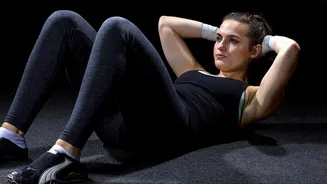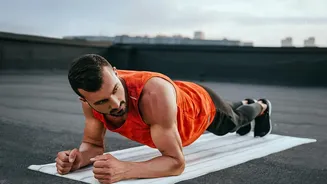






First, What Is Your Core?
Before comparing, it’s crucial to understand what the core actually is. It’s much more than just the 'six-pack' abs (rectus abdominis). Your core is a complex system of muscles that acts like a muscular box or cylinder in your midsection. This includes
deep abdominal muscles like the transverse abdominis, which wraps around your torso like a corset, muscles in your back, your diaphragm (the breathing muscle at the top), and the pelvic floor muscles at the bottom. Together, these muscles work to stabilize your spine and pelvis, protect your internal organs, and provide a solid foundation for all your movements.
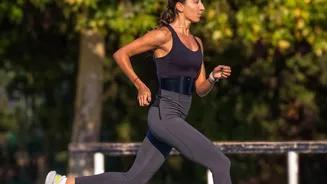
Core Training for Runners: Dynamic Bracing
When you run, your core has one primary job: to act as a steadfast stabiliser. Running is a high-impact, dynamic activity. With every stride, your body has to absorb force from the ground and keep your torso upright and stable, preventing it from twisting or bending excessively. This requires your core to maintain a strong, braced state. Think of it as creating a rigid link between your upper and lower body, allowing for an efficient transfer of power from your arms and torso to your legs. A strong, stable core prevents energy leakage, improves your running economy (how efficiently you use oxygen), and is crucial for maintaining good posture, especially as fatigue sets in during a long run. Without this stability, you risk inefficient form and a higher chance of injury.
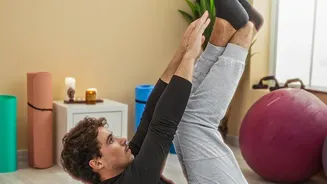
Core Training in Pilates: Controlled Activation
Pilates takes a fundamentally different approach. Here, the focus is less on bracing for impact and more on controlled, precise movement originating from a strong center. Often called the 'powerhouse,' the core in Pilates is the source of all movement. The training involves learning to consciously engage the deepest core muscles, particularly the transverse abdominis and pelvic floor, in a subtle but consistent way. This isn't a hard, rigid contraction but a gentle 'drawing in' or 'zipping up' sensation that supports the spine while allowing for fluid movement. Pilates also integrates a specific breathing technique, known as lateral breathing, which allows you to maintain this core engagement while fully oxygenating your muscles. The goal is to develop a deep mind-body connection, where you can initiate and control every motion from a stable, yet responsive, core.
The Key Difference: Stability vs. Control
The main distinction lies in the purpose of the engagement. In running, the core's role is largely reactive and isometric—it holds strong to resist external forces and maintain posture. It’s about creating stiffness and stability to support a repetitive, forward-moving action. In Pilates, the core's role is proactive and foundational. It's about consciously activating deep muscles to control the trunk's position while the limbs move through various ranges of motion. Pilates trains the core to be adaptable and intelligent, capable of modulating its engagement based on the task at hand. A runner's core training is about building a solid, unmoving platform; Pilates is about building a responsive, intelligent control center.
Why Runners Can Benefit from Pilates
This is where the two disciplines beautifully complement each other. While running strengthens the core in its bracing function, it doesn't always improve the deep, intrinsic muscle control that Pilates teaches. Many runners add Pilates to their routine specifically to enhance this area. A Pilates-trained core can lead to better running form, as it helps maintain pelvic stability and upright posture with less conscious effort. This improved body awareness and control can reduce the risk of common running injuries related to poor biomechanics. By teaching a runner to move more efficiently and with greater control from their center, Pilates builds a more resilient, powerful, and injury-proof athlete.