




A Philosophy of Harmony
The secret to Japan's picturesque urban oases lies in a philosophy that views humans and nature not as separate, but as interconnected. Rooted in ancient Shinto and Zen Buddhist beliefs, this worldview treats nature with deep respect. A garden or park
is more than just a recreational space; it's a spiritual one, designed to foster contemplation and calm. This approach dictates that even in the most crowded cities, space must be carved out for nature to thrive. The result is a landscape where a centuries-old shrine forest can exist just steps from a bustling train station, offering a complete escape from urban noise and stress. These green spaces are seen as essential for enriching the quality of life for all residents.
The Art of Imperfection and Borrowed Scenery
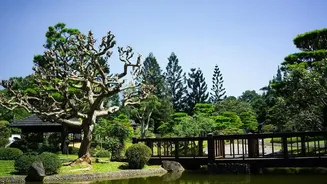
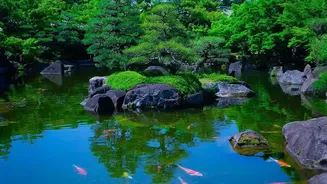
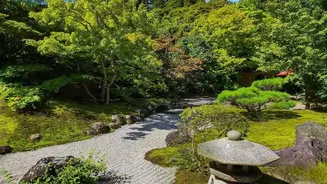
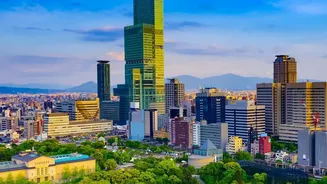
Japanese garden design is guided by sophisticated principles that have been refined over centuries. One key concept is wabi-sabi, which finds beauty in imperfection and the passage of time. This is why you might see a weathered stone covered in moss or an asymmetrically placed tree, elements chosen for their natural, unpretentious character. Another ingenious technique is shakkei, or "borrowed scenery." Garden designers cleverly incorporate views from outside the garden's borders—such as a distant mountain, a neighbouring temple roof, or even a cluster of skyscrapers—into the composition. This design trick makes the garden feel larger and seamlessly connected to the world beyond its walls.
From Feudal Estates to Public Havens
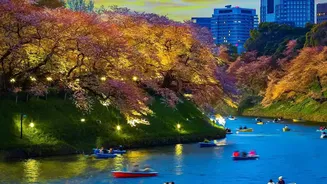
Many of Japan's most celebrated urban gardens have a fascinating history. They were originally the vast, private strolling gardens of feudal lords, known as daimyo, during the Edo period. These meticulously landscaped estates, such as Tokyo's Hama-rikyu Gardens and Koishikawa Korakuen, were designed as private playgrounds and spaces for reflection for the nobility. Following the Meiji Restoration in the 19th century, many of these exclusive properties were eventually opened to the public. This transition turned private aristocratic treasures into democratic spaces of public enjoyment, preserving their intricate designs and mature landscapes for everyone to experience.
Iconic Sanctuaries in the Concrete Jungle
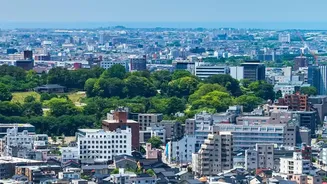
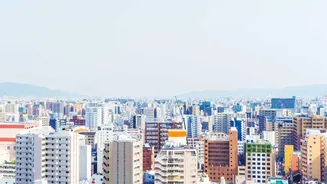
Tokyo, despite being one of the world's most populous megacities, is home to numerous examples of these principles in action. Meiji Jingu is a stunning example, a dense forest surrounding a shrine dedicated to Emperor Meiji and Empress Shoken. Its thousands of trees were donated from across Japan, creating an immersive woodland that completely isolates visitors from city noise. Shinjuku Gyoen National Garden is another jewel, masterfully blending three distinct styles: a traditional Japanese landscape, a formal French garden, and an English landscape garden. In Kyoto, the famed Arashiyama Bamboo Grove provides a completely different but equally immersive experience, where towering stalks of bamboo create a world of their own.
A Greener Future, Rooted in the Past
The tradition of integrating nature into urban life is not just a historical practice; it's a living, evolving one. Modern Japanese planners and developers continue to innovate, finding new ways to create green spaces. The "Miyawaki method," developed by botanist Akira Miyawaki, involves planting dense, multi-layered native forests that can reach maturity in just a few decades, a fraction of the time it normally takes. This technique is being used to create micro-forests in small urban plots. Furthermore, initiatives like Tokyo's "Green Biz" project are transforming the city with rooftop gardens, green-covered walls, and plans to convert old expressways into elevated parks, ensuring that this deep-seated harmony with nature will define Japan's cities for the next century.