
India's Watchful Eye on the Sun
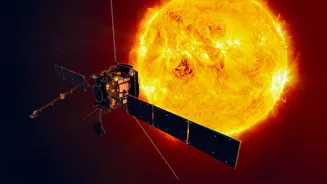
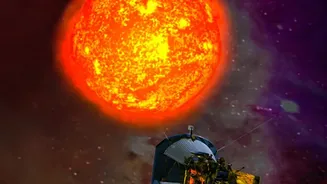
At the heart of this international effort is India's first dedicated solar observatory, Aditya-L1. Launched by ISRO, it is strategically positioned at the first Lagrange point (L1), a stable location 1.5 million kilometres from Earth that offers an uninterrupted
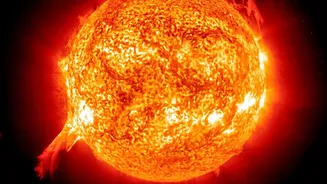
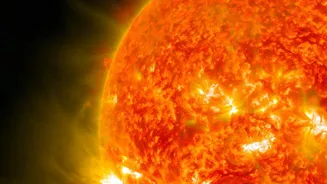
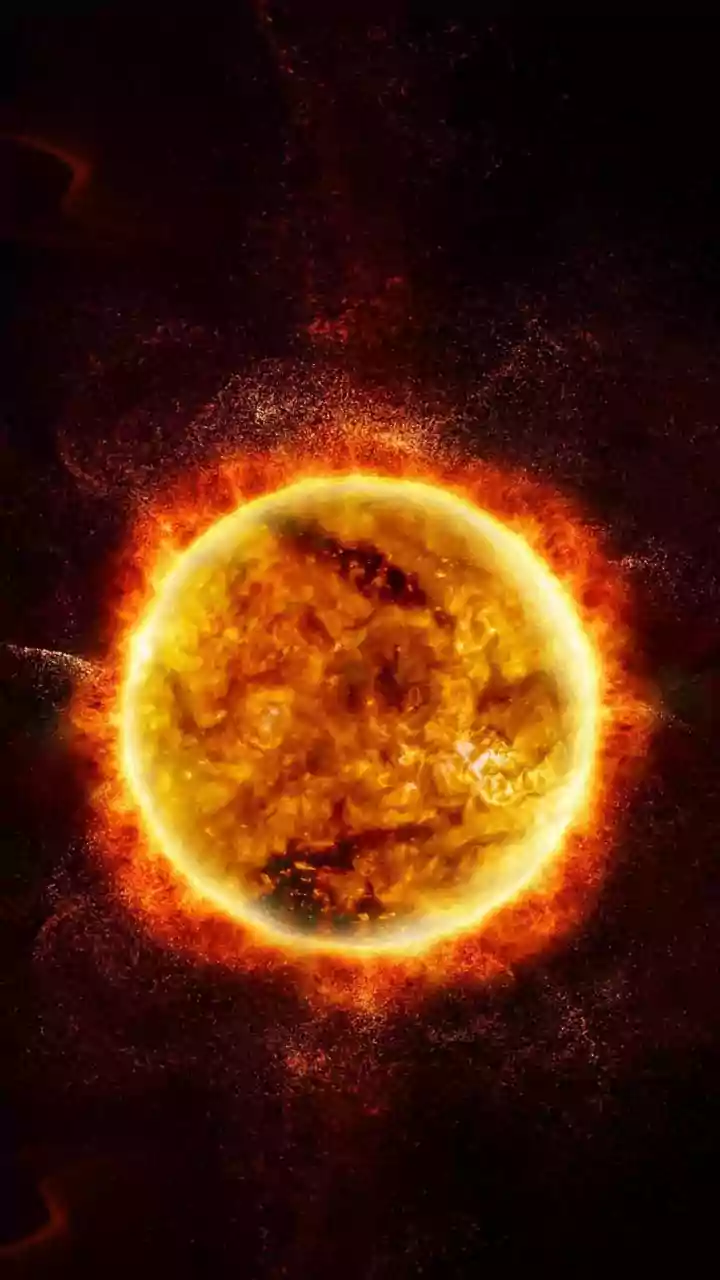
view of the Sun. Its key instrument for this task is the Visible Emission Line Coronagraph (VELC). Developed by the Indian Institute of Astrophysics, VELC is a sophisticated tool designed to study the Sun's outer atmosphere, the corona. It does this through spectroscopy, which analyses the properties of light to understand the material emitting it. This allows VELC to gather crucial data on the temperature and density of the super-heated plasma in the corona, especially during its earliest, most mysterious stages of an eruption.
Europe's Precision-Engineered Eclipse
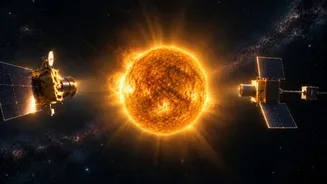
The other half of this dynamic duo is the ESA's Proba-3 mission, a marvel of engineering. It is the world's first precision formation-flying mission, consisting of two separate spacecraft flying in a tight, perfectly aligned formation approximately 150 meters apart. One spacecraft acts as a shield, blocking the direct light from the Sun, while the second spacecraft observes the faint, surrounding corona. This creates a near-perfect artificial solar eclipse in space, allowing its primary instrument, the ASPIICS coronagraph, to capture incredibly sharp images of the corona much closer to the Sun's surface than previously possible. These sharp images are vital for determining the shape, speed, and overall structure of a Coronal Mass Ejection (CME).
A Cosmic Collaboration in Action
Neither mission could achieve what they are now doing together. While Aditya-L1 and Proba-3 are separate missions, their instruments are designed to be complementary. By observing the same CME from their different vantage points, they create a stereoscopic, 3D view of the event. The first joint analysis focused on two CMEs that occurred in September 2025. The ASPIICS instrument on Proba-3 provided sharp images to calculate the eruption's shape and mass, while VELC on Aditya-L1 simultaneously provided spectroscopic data on the plasma's density and thermal energy. This synergy allows scientists to cross-check their data, building a more complete and accurate picture of how a solar storm evolves just moments after it erupts from the Sun.
Weighing a Solar Storm
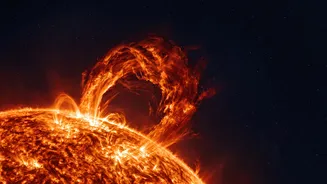
So how does this partnership 'weigh' a CME? A CME is an enormous cloud of plasma and magnetic fields, containing billions of tons of particles. Knowing its mass and density is crucial to predicting its potential impact. The brightness of a CME as seen by a coronagraph is related to its electron density. With a single viewpoint, it is difficult to distinguish between a large, tenuous cloud and a smaller, denser one. But with two distinct viewpoints, scientists can resolve this ambiguity. By combining the imaging data from ASPIICS and the spectroscopic density measurements from VELC, researchers can more accurately calculate the total mass of the ejected material and how that mass is distributed within the CME cloud. This provides critical constraints on the kinetic and thermal energy of the eruption, improving our fundamental models of solar physics.
Why This Matters for Life on Earth
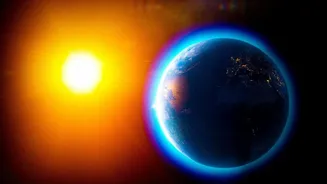
This advanced research is not just academic. CMEs are a primary component of space weather, which can have significant consequences for our technology-dependent world. A powerful CME directed at Earth can trigger geomagnetic storms capable of disrupting GPS navigation, damaging communication satellites, and even causing widespread blackouts by overloading power grids. By providing more accurate measurements of a CME's mass, density, and speed right after it leaves the Sun, this joint India-Europe initiative gives space weather forecasters more reliable data. Better data leads to better warnings, giving satellite operators and grid managers more time to take protective measures, ultimately helping to safeguard the critical infrastructure we rely on every day.