




An Event for the Other Side of the World
The most important fact for sky-gazers in India is that this partial lunar eclipse will not be visible from anywhere in the country. The entire celestial event unfolds during the daytime for the Indian subcontinent, meaning the Moon will be below the horizon
and out of sight. The eclipse will occur during the morning and afternoon hours in India, while it is still nighttime across the Americas, Europe, and Africa. Residents in cities like New York, London, Paris, and Johannesburg will be the primary audience for this astronomical spectacle. So, while you may see incredible photos online, they will be coming from observers in the Western Hemisphere.
What Makes This Eclipse Special?
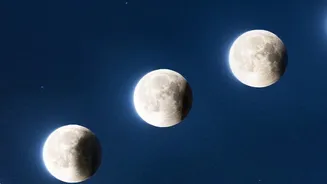
A lunar eclipse happens when the Earth positions itself directly between the Sun and the full Moon, casting its shadow onto the lunar surface. In a partial eclipse, this alignment isn't perfect, so only a portion of the Moon passes through the darkest part of Earth's shadow, known as the umbra. This particular event on August 28 is considered a very deep partial eclipse. At its peak, nearly 93-96% of the Moon's diameter will be covered by the umbra, making it appear as if a large, dark bite has been taken out of it. For those in the visibility zone, the shadowed part of the Moon may even take on a coppery-red glow, similar to what is seen during a total lunar eclipse.
Eclipse Timings Explained for India
To understand why the eclipse is not visible, it helps to look at the timings in Indian Standard Time (IST). The faint outer phase, the penumbral eclipse, is set to begin around 6:54 AM IST on August 28. The more noticeable partial phase starts at 8:04 AM IST. The moment of greatest eclipse, when the Moon is deepest in shadow, will occur at 9:43 AM IST. The event concludes long before the Moon rises in India in the evening. Since these times are all during broad daylight in India, our side of the planet will be facing the Sun, making it impossible to see the eclipsed Moon.
The Final Lunar Eclipse of 2026
This event is the second and final lunar eclipse of 2026. The year also featured a total lunar eclipse on March 3 and two solar eclipses. This partial eclipse effectively closes the curtain on the year's lunar shadow plays. For those in India eager to witness such a phenomenon, the wait will not be too long. The next lunar eclipse visible from the region will occur in 2027, though it will be a much fainter penumbral eclipse. This makes the August 28 event a significant one for global viewers, marking the last deep lunar eclipse for some time.
No 'Sutak' or Rituals Applicable
The eclipse coincides with the festival of Raksha Bandhan in India, which has led to questions about religious observances. According to Hindu tradition, a period known as Sutak Kaal is observed when an eclipse is visible. However, because this Chandra Grahan is not visible from India, Sutak will not be applicable. All rituals, including those for Raksha Bandhan, can be performed as usual without any restrictions related to the eclipse. Temples will remain open, and daily routines will not need to be altered.