




Tashkent: A Blend of Modern and Soviet Charm
Your journey will likely begin in Tashkent, the vibrant capital. It's a sprawling city where modern avenues, Soviet-era architecture, and old mahallas (neighbourhoods) coexist. Don't miss a ride on the Tashkent Metro, where each station is a unique work
of art, adorned with mosaics, chandeliers, and intricate designs. Visit the Hast-Imam Square, the religious heart of the city, which houses the world's oldest Quran. For a taste of local life, wander through the bustling Chorsu Bazaar, a massive blue-domed market where you can find everything from fresh produce and spices to traditional crafts. Tashkent also serves as a reminder of a poignant moment in Indian history as the city where Prime Minister Lal Bahadur Shastri signed a peace treaty and spent his final days.
Samarkand: The Crossroads of Culture
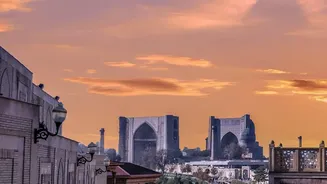
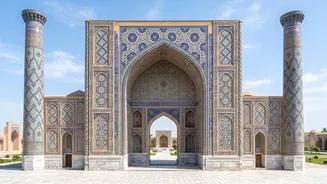
No trip to Uzbekistan is complete without visiting Samarkand, a city whose name alone evokes the magic of the Silk Road. Its crown jewel is the Registan Square, an awe-inspiring ensemble of three grand madrasahs: Ulugh Beg, Sher-Dor, and Tilya-Kori. Their azure domes and intricate tilework are a sight to behold, especially at sunrise and sunset. Another key site is the Gur-e-Amir Mausoleum, the final resting place of the conqueror Timur, whose architectural style is said to have influenced the Taj Mahal. The city also has a direct connection to Indian history through Timur's descendant, Babur, the founder of the Mughal Empire, who was born in present-day Uzbekistan.
Bukhara: The Soul of the Silk Road
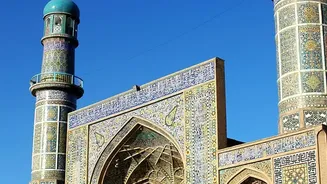
If Samarkand is majestic, Bukhara is intimate and enchanting. A UNESCO World Heritage site, its historic centre is a largely preserved ancient city that feels like a living museum. You can spend days getting lost in its labyrinthine alleys, discovering mosques, madrasahs, and caravanserais at every turn. The Poi Kalyan Complex, with its towering minaret that once served as a beacon for caravans, is the city's architectural centerpiece. Explore the Lyabi-Hauz complex, a plaza built around a tranquil pond, and visit the Samanid Mausoleum, a masterpiece of 10th-century Islamic architecture. Bukhara’s charm lies in its atmosphere, where the past feels palpably present.
Khiva: A Living Open-Air Museum
The farthest of the Silk Road cities, Khiva is arguably the most atmospheric. Its inner city, Itchan Kala, is a perfectly preserved walled fortress, a feature that sets it apart from Samarkand and Bukhara. Stepping through its gates is like entering another century. Inside the 10-metre-high mud-brick walls, you'll find over 50 historical monuments, including the unfinished but stunning Kalta Minor Minaret, covered in turquoise tiles, and the Juma Mosque, with its forest of 212 carved wooden columns. Climb the city walls near the West Gate for a spectacular sunset view over this sand-coloured city. A ticket allows access to most sites within Itchan Kala for 48 hours, giving you ample time to explore this sand-castle city.
Making the Journey: Travel for Indians
Uzbekistan has become increasingly accessible for Indian tourists. In August 2026, the country announced a 30-day visa-free entry policy for Indian citizens, aiming to boost tourism and cultural ties. While travellers should always check for the official start date and latest rules before booking, this move simplifies planning significantly. Direct flights connect major Indian cities like Delhi and Hyderabad to Tashkent, making the physical journey straightforward. Airlines like Uzbekistan Airways and Centrum Air operate regular flights, bridging the distance between the two historically connected nations.