



More Than Just a Splash
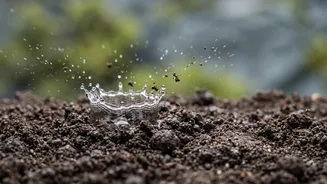
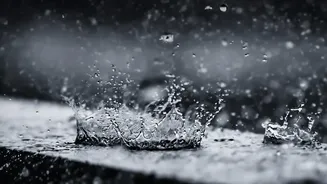
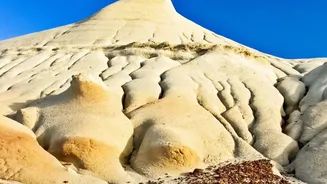
When a raindrop hits bare soil, it acts like a small bomb. This impact, known as splash erosion, is the first stage of soil degradation by water. Over billions of drops in a storm, it dislodges huge quantities of soil, which can then be washed away. This process
reduces soil fertility, clogs waterways with sediment, and can even damage building foundations. For decades, scientists have worked to understand the precise physics of this impact to better predict and prevent its effects. The common understanding focused on the direct pressure of the drop cratering the surface, but it turns out there is more to the story.
What We Thought We Knew
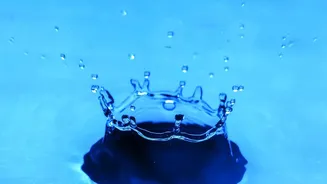
Previously, the prevailing model of rain-droplet erosion was relatively straightforward. It centred on the kinetic energy and momentum of the falling drop. Scientists believed that the primary force dislodging soil particles was the immense pressure generated at the moment of impact, similar to how a hammer strike deforms a surface. This "piston-like" action was thought to create a crater and fling particles outward. Consequently, efforts to model and mitigate erosion were largely based on calculating the energy of rainfall and the resistance of the soil surface. This model was useful but incomplete, as it couldn't fully account for the amount of soil displaced or the surprising efficiency of the process. Researchers suspected something was missing from the equation.
A Shockwave in Understanding
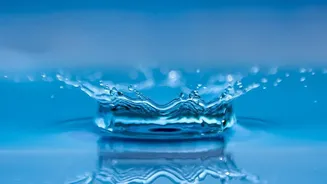
The latest research has revealed a far more complex and powerful mechanism. Using a new technique called high-speed stress microscopy, researchers were able to measure the hidden forces underneath a droplet as it hits a hard surface. They discovered that the force is not concentrated at the centre of the droplet. Instead, it spreads out with the impacting drop, and for a short time, the speed at which the droplet spreads exceeds the speed of sound. This creates a shock wave that moves across the surface. It’s this shockwave, generating significant shear stress, that is responsible for the erosion, explaining how a soft liquid can damage a hard surface. It is not just one action, but a rapid, high-pressure event that radiates outward.
Why This Changes Everything
This new understanding of the shockwave effect has significant implications. For one, it means our current models for predicting soil loss and material damage may need revision. The shear stress created by the spreading drop is now a critical variable that needs to be factored in. This knowledge is invaluable for agriculture, especially in a country like India where intense monsoon rains are a major cause of soil erosion. Farmers and soil conservationists can now develop more effective strategies. Instead of just focusing on ground cover to absorb the initial impact, new techniques might aim to disrupt the supersonic spread of the water, perhaps by altering soil texture or using specific types of mulch that interfere with the flow.
Beyond the Farm
The findings are not just limited to soil. The physics of droplet impact and erosion are relevant in many other fields. In material science, understanding this shockwave mechanism can help in designing more durable, erosion-resistant surfaces for everything from wind turbine blades to aircraft coatings and buildings that must withstand weathering. In planetary science, it could refine models of how landscapes on other planets might have been shaped by liquid in their distant past. By providing a more accurate physical model, this research opens up new avenues for innovation and a deeper appreciation for the intricate forces shaping our world, one raindrop at a time.