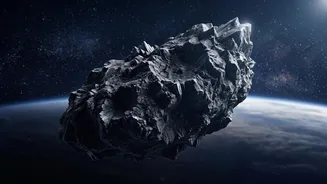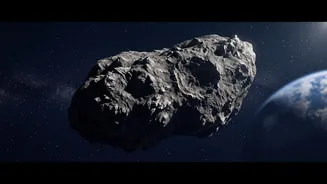







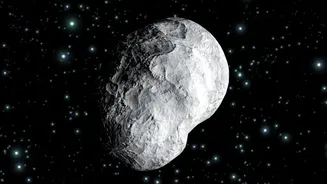

NASA's successful DART mission proved humanity could nudge a threatening asteroid off course. But new 'in silico' experiments—powerful computer simulations—reveal a critical wrinkle: a space rock's irregular shape dramatically changes the game.
A Landmark Success in Planetary Defense
In September
2022, the world watched as NASA's Double Asteroid Redirection Test (DART) spacecraft deliberately crashed into Dimorphos, a small moonlet orbiting the larger asteroid Didymos. The mission was a resounding success. It wasn't just a proof-of-concept; it was the first time humanity had purposefully altered the motion of a celestial body. The impact changed Dimorphos's orbit around Didymos by 33 minutes, far exceeding scientists' more modest predictions. The kinetic impactor technique—essentially, hitting an asteroid with a projectile to knock it off course—was validated as a viable planetary defense strategy. For a moment, it seemed like a straightforward solution to one of nature's biggest potential threats. But as scientists dig deeper into the data, they are uncovering layers of complexity that challenge our initial assumptions.
From Physical Impact to Digital Laboratory
Following the DART mission, researchers have been running sophisticated computer simulations—known as 'in silico' experiments—to better understand the mechanics of asteroid deflection. These models allow scientists to test scenarios that are impossible or impractical in the real world. Instead of just re-creating the DART impact, they can change the variables: the asteroid’s composition, its spin, and most importantly, its shape. Early models often treated asteroids as simple spheres, a necessary simplification to make the calculations manageable. However, we know from missions like Hayabusa2 and OSIRIS-REx that many asteroids are not solid, spherical boulders. Instead, they are often 'rubble piles'—loose collections of rocks, dust, and gravel held together by weak gravity. They also come in a variety of irregular shapes, from elongated like a potato to dumbbell-like structures.
Why Shape Changes Everything
A recent study published in the journal Icarus highlights just how much shape matters. Researchers at Sandia National Laboratories ran simulations of a nuclear device detonating near an asteroid—a proposed method for deflecting very large or short-notice threats. The idea is not to shatter the asteroid, but to use the blast of X-ray radiation to vaporize one side of its surface, creating a powerful thrust that pushes it off course. The simulations used the known, irregular shapes of three real asteroids: Bennu, Itokawa, and Golevka. The results were startling. Depending on which side of the lumpy, uneven asteroid was targeted, the resulting change in velocity could vary by a factor of five. Hitting a flat face provides a much more efficient push than hitting a sloped side or a protruding lump, where the force could be partially wasted or even induce an unpredictable spin. It’s the difference between pushing a box squarely from behind versus shoving it on a corner.
The internal structure of an asteroid adds another layer of complexity. The DART mission itself provided a clue: the impact was far more effective than predicted, likely because Dimorphos is not a solid rock but a loose rubble pile. The impact didn't just push the asteroid; it sent a massive plume of debris flying into space, and that ejecta provided a powerful secondary push, like the recoil from a gun. Simulations from Johns Hopkins Applied Physics Laboratory show how an impact on a rubble-pile asteroid can cause subsurface boulders to shatter and erupt, making the outcome much harder to predict than hitting a solid object. The shape and composition are interconnected. An irregularly shaped asteroid is more likely to be a rubble pile formed from the debris of an older collision. This means any attempt to deflect it must account for both its lumpy exterior and its potentially loose interior. An impact could transfer momentum cleanly, or it could simply be absorbed by the shifting rubble, much like punching a beanbag.
These findings have profound implications for future planetary defense planning. The key takeaway is that a 'one-size-fitsall approach will not work.' Deflecting a threatening asteroid requires a detailed preliminary investigation. Before launching a kinetic impactor or any other mitigation mission, we would first need to send a reconnaissance probe to characterize the target. We need to know its precise shape, its rotation, its mass, and whether it is a solid monolith or a looselybound pile of cosmic debris. This makes planetary defense a much more complex multi stage process. Some research even warns that hitting an asteroid in the wrong spot could accidentally steer it into a 'gravitational keyhole'—a region in space where Earths gravity could later pull it back onto a collision course. Therefore aim matters immensely and you cant aim properly if you dont know the targets shape.