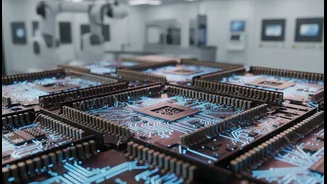








From Software Giant to Silicon Sovereign
For decades, India's contribution to the global technology value chain was primarily in chip design and software development—the brains of the operation, but not the physical production. The country designs a significant portion of the world's chips but manufactures
almost none, creating a critical dependency on imports for everything from smartphones to military hardware. This vulnerability was starkly exposed by recent global supply chain disruptions, prompting a strategic pivot. The goal is no longer just to design chips but to manufacture them, transitioning from a software services hub to an end-to-end technology powerhouse. This push for 'technological sovereignty' is seen as a national security imperative and a cornerstone of future economic resilience.
The India Semiconductor Mission Takes Center Stage
The government's answer to this challenge is the India Semiconductor Mission (ISM), a multi-billion dollar initiative designed to build a complete domestic ecosystem. Following an initial phase, the recently approved 'Semicon 2.0' has an outlay of ₹1.275 trillion (US$13.23 billion) and expands the focus beyond just building massive fabrication plants (fabs). This new phase aims to bolster the entire value chain, including incentives for companies that manufacture semiconductor production equipment, specialty chemicals, and advanced materials. The policy provides significant financial support, offering to cover a large percentage of the colossal capital expenditure required to set up chip manufacturing and packaging units, aiming to attract global players and empower domestic companies.
Foundations of a New Industry
The mission is already translating into concrete projects on the ground. In Gujarat, two major projects are taking shape. Tata Electronics, in partnership with Taiwan's PSMC, is building India's first major commercial semiconductor fab in Dholera, an approximately $11 billion project. This plant, which has already reached significant construction milestones, is expected to produce its first chips by late 2026, focusing on mature nodes used in automotive, consumer electronics, and power management. Nearby in Sanand, US-based Micron Technology has inaugurated a large-scale assembly and test facility, representing a $2.75 billion combined investment. This facility has already begun commercial production, marking India's entry into the semiconductor packaging space and shipping its first made-in-India memory modules.
The Immense Challenges Ahead
The ambition is matched only by the scale of the challenges. Semiconductor manufacturing is one of the most complex and capital-intensive industries in the world. Setting up a fab requires massive investment, an uninterrupted supply of ultra-pure water and stable power, and a pristine, dust-free environment where a single speck can ruin entire batches of chips. India currently imports over 90% of the specialized equipment and many of the raw materials needed for production. Perhaps the most significant hurdle is the talent gap. While India has a strong base of design engineers, it faces a shortage of professionals skilled in the hands-on, operational side of chip manufacturing and fabrication. Closing this gap between academic knowledge and industry-ready skills is critical for the mission's long-term success.
Powering India's AI Future
Ultimately, the drive for domestic chips circles back to the headline ambition in artificial intelligence. AI doesn't run on code alone; it runs on specialized, high-performance silicon. By building a domestic manufacturing base, India aims to secure the foundational layer for its AI-driven future, reducing reliance on geopolitical rivals and securing a trusted supply of chips for its data centers, defense systems, and burgeoning electronics industry. Controlling the hardware means India can shape its own technological destiny, ensuring its AI models are powered by chips it can produce at home. This isn't just about building factories; it's about building the engine for India’s next generation of technological innovation and economic growth.