


The Celestial Middle Child
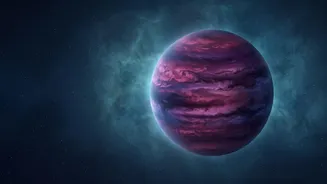
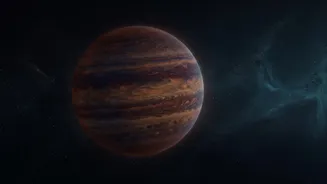
Often called 'failed stars', brown dwarfs are the universe's ambitious underachievers. They are born from the same collapsing clouds of gas and dust that create stars. However, they never accumulate enough mass to kickstart the nuclear fusion of hydrogen
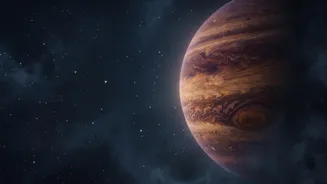
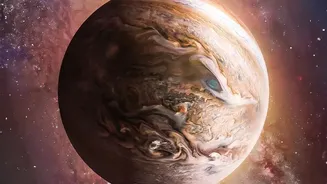
in their cores, the process that makes stars like our sun shine brightly. While they are more massive than even our largest gas giants—ranging from about 13 to 80 times the mass of Jupiter—they lack the gravitational might to become a true star. Instead of a sustained, brilliant light, they emit a faint, dim glow, primarily in the infrared spectrum, from the heat of their formation and the short-lived fusion of a heavier hydrogen isotope called deuterium. Over billions of years, they simply cool and fade, making them incredibly difficult to detect.
Pushing the Lower Limits
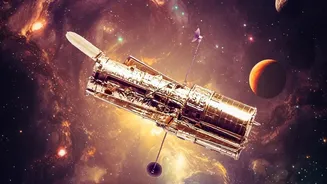
For years, astronomers debated the lower mass limit for an object to form like a star. But recent observations from NASA's James Webb Space Telescope (JWST) have thrown a wrench in those theories. In a nearby star-forming region named IC 348, astronomers were stunned to find free-floating brown dwarfs with masses as low as just two to four times that of Jupiter. This discovery, published in late 2025 and 2026, pushes deep into territory previously thought to belong exclusively to giant planets. It challenges the very models of how stars form, suggesting that the process of gravitational collapse can produce objects far smaller than once believed possible. The question for scientists is no longer if star formation can create planet-sized objects, but how far down the scale it can actually go.
A New Cosmic Chemistry
The surprises didn't stop with their size. The spectra of these tiny brown dwarfs revealed an unusual and as-yet-unidentified hydrocarbon molecule in their atmospheres. This unexpected chemical signature has led some astronomers to propose an entirely new spectral classification, the 'H' class, to categorize these unique objects. Adding to this complexity, another NASA mission, SPHEREx, has been studying the atmospheres of thousands of brown dwarfs. Its findings, released in October 2026, show that their atmospheres are rich with molecules like methane and carbon dioxide, similar to giant planets. The mission also confirmed that even at the same temperature, no two brown dwarfs are exactly alike, with their clouds and chemical compositions showing significant variation. This diversity challenges the models scientists use to understand these dim worlds.
Worlds That Might Create Worlds
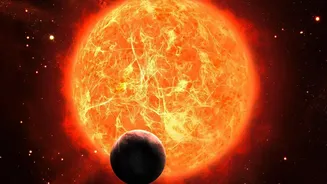
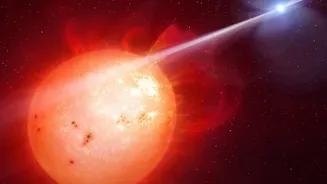
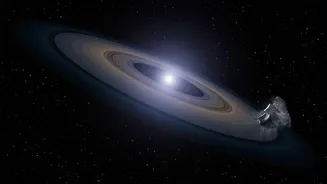
Perhaps the most mind-bending discovery is that one of these newly found, planet-sized brown dwarfs shows evidence of a dusty disk surrounding it—the very same raw material from which planets are born. This raises the tantalizing and bizarre possibility that an object only a few times more massive than Jupiter could host its own system of planets. The discoveries are painting a picture of a universe more creative than we imagined. In another recent finding from October 2026, astronomers observed a star system where a red dwarf star is slowly 'snacking' on its brown dwarf companion over billions of years, rather than swallowing it whole. This reveals a completely new, gentler way these celestial bodies can interact. From their formation to their evolution, brown dwarfs are proving to be a treasure trove of cosmic surprises.