



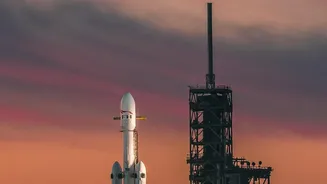
The Old Way: A Tradition of Waste
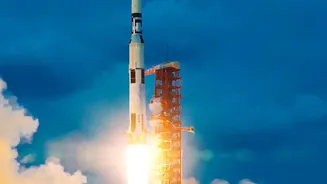
Imagine if every time a commercial aeroplane landed, it was immediately scrapped. Air travel would be impossibly expensive for almost everyone. For most of spacefaring history, this was exactly how rocketry worked. Each launch required a brand-new vehicle,
with its most expensive components—the powerful first-stage boosters—either burning up in the atmosphere or crashing into the ocean after just a few minutes of use. This single-use model meant that accessing space was an incredibly expensive and time-consuming endeavour, largely restricted to government agencies and major corporations. Building a new rocket from scratch for every single mission created a significant bottleneck, limiting how often we could launch and what we could afford to send to orbit and beyond.
The Reusability Revolution
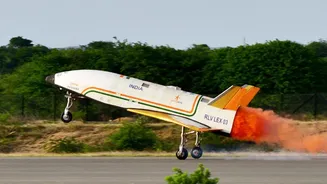
The game-changing idea was to treat rocket boosters less like disposable packaging and more like aircraft. Companies like SpaceX, Blue Origin, and Rocket Lab pioneered the concept of reusable launch vehicles. The core principle is simple: design the first stage of the rocket, which contains the most expensive engines and hardware, to survive its journey and return to Earth for a controlled landing. Once recovered, the booster can be inspected, refurbished, and prepared for another flight. This shift fundamentally alters the economics of space access. Instead of incurring the full cost of manufacturing a new booster for every launch, that cost can be spread across multiple missions.
How a Rocket Lands Itself
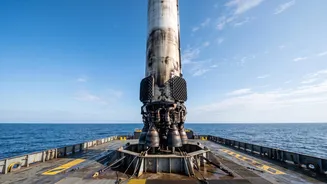
Landing a 14-story structure falling from the edge of space is a complex dance of physics and engineering. After separating from the second stage high in the atmosphere, the booster performs a series of precise manoeuvres. First, it uses small cold gas thrusters to flip 180 degrees. Then, it fires several of its main engines in what's called a 'boostback burn' to adjust its trajectory toward the landing zone—either a concrete pad on land or an autonomous droneship at sea. As it re-enters the dense part of the atmosphere at supersonic speeds, it executes an 'entry burn' to slow down and protect itself from extreme heat. Steerable grid fins, which are lattice-like structures near the top of the booster, deploy to help guide its descent with incredible accuracy. In the final seconds, a 'landing burn' using one or more engines brings the booster to a gentle touchdown as its landing legs deploy.
The Economic Impact: Drastic Cost Reduction
The primary benefit of reusability is a massive reduction in launch costs. The first-stage booster accounts for a huge portion of a rocket's total manufacturing cost. Building a new one can cost tens of millions of dollars, whereas refurbishing a previously flown booster can be done for a fraction of that price—in some cases, for less than 10% of the cost of a new one. This has driven down the price per launch dramatically. For example, the cost to send a kilogram of payload to low Earth orbit has dropped from over $10,000 to around $2,500. These savings make space more accessible to a wider range of customers, from satellite startups to scientific researchers, fostering a new wave of innovation.
More Than Just Savings
Reduced cost is just the beginning. Landing rocket boosters also significantly increases the potential launch frequency. Instead of waiting months or years for a new rocket to be built, a refurbished booster can be ready for its next flight in a matter of weeks. This rapid turnaround has been crucial for the deployment of satellite mega-constellations like Starlink, which require hundreds of launches. Furthermore, reusability has an environmental benefit by reducing the amount of hardware left as space debris or dumped in the ocean. Each reused booster means fewer resources are consumed in manufacturing. This makes space exploration more sustainable, which is a critical consideration as the number of global launches continues to grow.
The Future is Fully Reusable
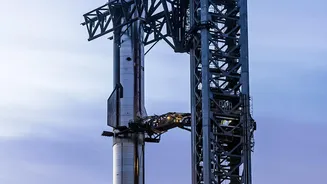
While companies like SpaceX have mastered partial reusability with the Falcon 9, the industry is already moving toward the next frontier: fully reusable rockets. Systems like SpaceX's Starship are being designed so that both the booster and the upper stage (the spacecraft itself) can be recovered and reflown. This would drive costs down even further, potentially making interplanetary travel economically feasible. Other players, including Blue Origin with its New Glenn rocket and various European firms, are also developing their own reusable technologies. This competitive push is accelerating innovation, with the ultimate goal of making access to space as routine and affordable as air travel is today.