



The Universe's Ghost Particle
Trillions of neutrinos pass through your body every second, yet you never feel them. These elementary particles are one of the universe's fundamental building blocks, but they are so light and electrically neutral that they rarely interact with any matter.
This ghostly nature, however, is exactly what makes them perfect cosmic messengers. While light can be trapped and scattered inside a star for ages, neutrinos zip out of a star's dense core almost instantly, carrying direct information about the nuclear reactions happening deep within. They are produced in mind-boggling quantities during the final moments of a massive star's life, carrying away about 99% of the gravitational energy released during its collapse.
A Star's Explosive Choice
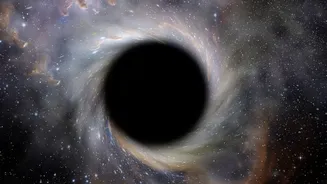
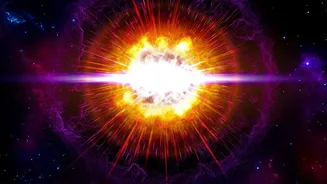
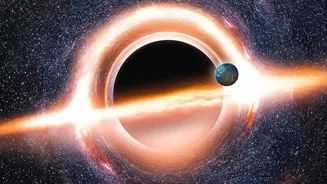
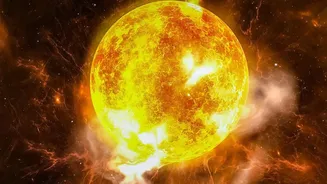
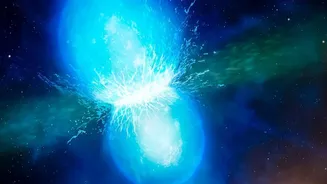
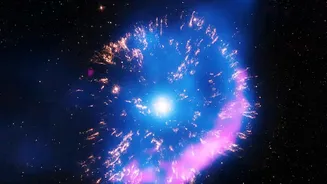
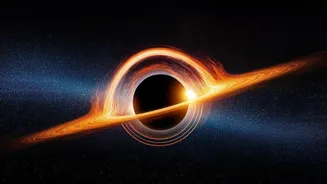
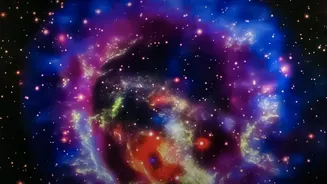
For years, one of the great unanswered questions in astrophysics has been what determines the final fate of a massive star. When a star much larger than our sun runs out of fuel, its core implodes under its own immense gravity. This collapse triggers a massive flood of neutrinos. In some cases, these neutrinos deposit enough heat and energy into the surrounding layers of the star to trigger a cataclysmic explosion known as a supernova, leaving behind a super-dense neutron star. In other cases, the heating isn't enough, the explosion fails, and the star continues to collapse into a black hole. Scientists have long theorised that neutrinos play the deciding role, and new research is adding a fascinating twist to the story.
A Surprising 'Flavor Change'
The key new finding revolves around a strange property of neutrinos called 'flavor conversion'. Neutrinos come in three types, or 'flavors': electron, muon, and tau. As they travel, they can spontaneously switch from one flavor to another. For a long time, astrophysicists thought these flavor changes had a negligible effect on a star's explosion. However, a new study from researchers at the University of Copenhagen suggests this is not the case. By running 195 simulations of collapsing stars, they found that including these flavor changes in their models had a dramatic impact on the outcome. The change in flavor affects how neutrinos interact with matter, influencing whether they provide the necessary 'kick' for a supernova explosion.
The Stellar Sweet Spot
The most surprising result from the simulations was that stars within a specific mass range—between 16 and 30 times the mass of our sun—were particularly sensitive to these neutrino flavor changes. In standard simulations that didn't account for flavor conversion, many stars in this range would explode as supernovae. But when the new physics was included, a significant number of them failed to explode and instead collapsed into black holes. According to Irene Tamborra, a co-author of the study, this specific mass range turned out to be a kind of 'sweet spot' where the subtle physics of neutrinos can completely flip the star's fate. This discovery could help solve other cosmic mysteries, such as why astronomers have detected fewer supernovae than theoretical models predict.
No Risk To Our World
While these findings describe incredibly violent and energetic cosmic events, it is crucial to understand that they pose no threat to Earth. The headline itself notes this, and the science confirms it. These processes happen in stars far more massive than our sun, at distances of hundreds or thousands of light-years away. The neutrinos themselves, though numerous, pass harmlessly through our planet and everything on it. The research is not a prediction of a new danger, but rather a refinement of our understanding of the universe's mechanics. It helps physicists and astronomers build more accurate models of how stars live, die, and create the heavy elements that make up planets and even life itself.