


A Picture Worth a Thousand Mysteries
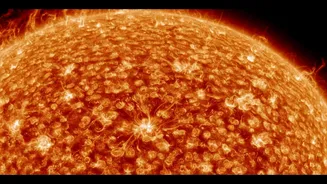
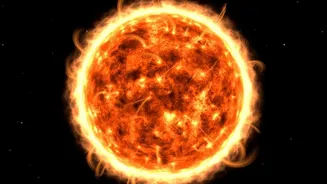
The image in question, captured by the National Science Foundation's Daniel K. Inouye Solar Telescope in Hawaii, is the highest-resolution picture of the sun's surface ever taken. It reveals a turbulent, boiling pattern of plasma that covers our star.
These cell-like structures, called granules, are each about the size of Texas and are the visible signature of convection—the process that transports heat from the sun's interior. In this cosmic kettle, hot plasma rises in the bright centers of the granules, cools, and then sinks back down in the dark lanes separating them. While scientists have known about granulation for years, we've never seen it with this staggering clarity, resolving features as small as 30 kilometres across.
Seeing a Long-Theorized Phenomenon
What makes these new images particularly groundbreaking is the confirmation of a phenomenon that was, until now, only theoretical. At the edges of the granules, where the cooling plasma sinks back into the sun, the telescope revealed tiny, whirlpool-like patterns. Scientists have identified these as the Kelvin-Helmholtz instability, which occurs when two fluids or plasmas moving at different speeds shear past each other. You can see a similar effect when wind blows over water, creating waves. On the sun, this instability happens at the boundaries of the powerful magnetic fields, creating swirls and eddies that were previously too small to see. This is the first direct, experimental proof that this process happens on the sun's visible surface.
Solving the Coronal Heating Puzzle
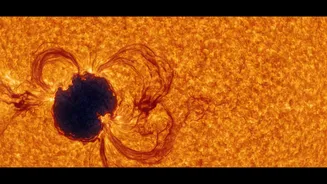
The discovery of these instabilities is more than just a neat observation; it may be the key to one of the biggest unsolved mysteries in solar physics: the coronal heating problem. For decades, astronomers have been perplexed as to why the sun's outer atmosphere, the corona, is millions of degrees hotter than its surface, which is a relatively cool 6,000 degrees Celsius. The laws of thermodynamics suggest this shouldn't happen. One leading theory is that energy is transferred from the surface to the corona through complex magnetic processes. The newly-observed instabilities are thought to play a crucial role, channeling energy from the roiling surface up into the corona along magnetic field lines. Observing these city-sized swirls could finally provide the data needed to confirm how the sun's atmosphere gets superheated.
Why It Matters Here on Earth
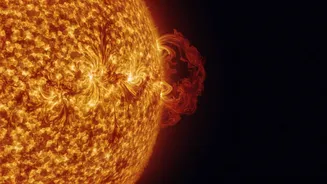
Understanding the fundamental physics of our star isn't just an academic exercise. The sun drives space weather—a stream of charged particles and magnetic fields that flow out into the solar system. Major events, like solar flares and coronal mass ejections (CMEs), can have significant impacts on Earth. These solar storms can disrupt our communications satellites, damage power grids, and pose a risk to astronauts. By creating more accurate models of the sun's behavior, which these high-resolution images enable, scientists can improve their ability to forecast space weather. Knowing how and why the sun transfers energy and releases massive explosions gives us a better chance to predict these events and protect our increasingly technology-dependent infrastructure.