




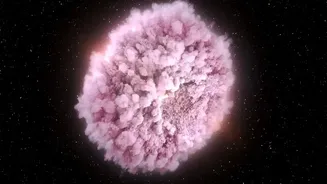
Cosmic Crossroads: Supernova or Black Hole?
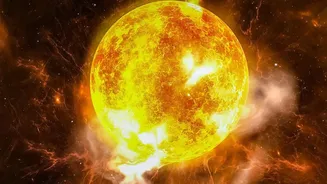
The universe is shaped by the dramatic deaths of massive stars. When a star at least eight times more massive than our Sun runs out of fuel, its core implodes under its own immense gravity. This event, called a core-collapse, triggers one of two fates:
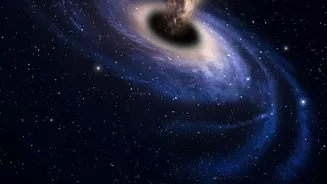
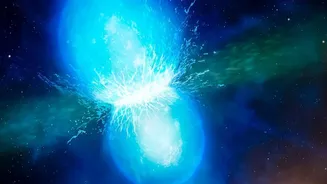
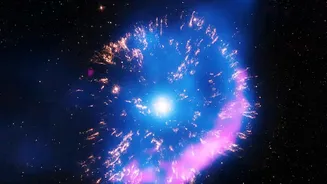
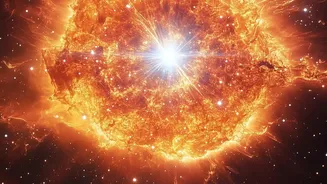
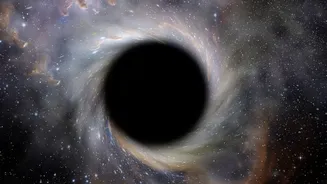
a spectacular supernova explosion that forges and scatters heavy elements, leaving behind a dense neutron star, or a failed explosion where the star collapses entirely, forming a black hole. For decades, astrophysicists have tried to understand what determines this cosmic fork in the road. Now, new research suggests that a major clue lies with neutrinos, the most elusive particles in the cosmos.
The Ghost Particle's Powerful Role
Neutrinos are fundamental particles so tiny and weakly interacting that trillions pass through you every second unnoticed. Yet, in the extreme environment of a dying star, they are produced in unimaginable numbers, carrying away about 99% of the collapse's energy. This torrent of neutrinos is believed to be the engine that powers a supernova. As they stream out from the collapsed core, a fraction of them are absorbed by the surrounding stellar material. This process, called neutrino heating, can provide the crucial push needed to reverse the collapse and trigger a cataclysmic explosion. Without it, the explosion would stall, and the star would be doomed to become a black hole.
A Digital Lab of 195 Dying Stars
To investigate the role of neutrinos, a recent study led by researchers at the University of Copenhagen’s Niels Bohr Institute performed a massive computational experiment. They simulated the final moments of 195 different stars, with masses ranging from nine to 120 times that of our Sun. The key innovation in their work was to incorporate a subtle but important aspect of neutrino physics known as 'flavor conversion'. Neutrinos come in three types, or 'flavors', and can switch between them as they travel. While previously thought to be a minor detail, this new study tested how these flavor changes deep within the star's core could alter the outcome of the collapse.
A Surprising Sensitivity
The simulations delivered a surprising result. While the neutrino flavor changes affected stars across the mass range, one group stood out for its extreme sensitivity: stars between 16 and 30 solar masses. In standard models that don't include flavor conversion, many stars in this mass range explode successfully. However, when the researchers factored in the flavor-changing behavior of neutrinos, a large number of these simulated explosions failed. The change in neutrino flavors altered the efficiency of the heating process, tipping the scale for these 'on-the-edge' stars from a successful supernova to a complete collapse into a black hole.
Solving Longstanding Cosmic Puzzles
This finding could be a major piece of the puzzle for several astronomical mysteries. For instance, astronomers have long noted that they observe fewer supernovae than theoretical models predict. The idea that neutrino flavor changes can prevent explosions in a specific mass range could help account for this discrepancy. It may also explain observations of 'disappearing' red supergiant stars, which seem to vanish without a supernova—they might be collapsing directly into black holes. Furthermore, the study suggests that this mechanism could lead to the formation of lower-mass neutron stars, which have also been observed but were difficult to explain with previous models.