




Our Cosmic Neighbor Under the Microscope
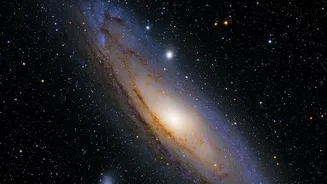
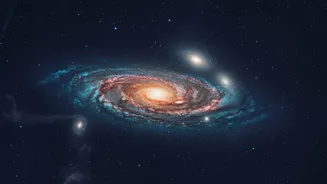
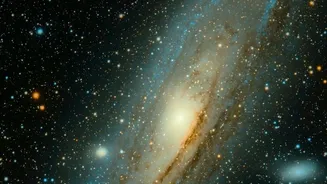
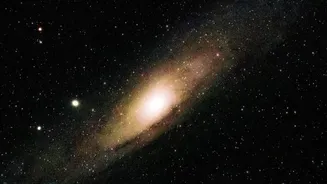
At a distance of 2.5 million light-years, the Andromeda galaxy (M31) is the closest major spiral galaxy to our own Milky Way. It's so close, in fact, that it can be seen with the naked eye from a dark-sky location, appearing as a faint, fuzzy patch of light.
This proximity makes Andromeda an invaluable laboratory for astronomers. Unlike our view of the Milky Way, which is obscured because we are inside it, we can get a panoramic, outside-in perspective of Andromeda. This allows scientists to study the entire lifecycle of a galaxy in stunning detail, providing clues about how galaxies like ours form, evolve, and eventually die.
A Stellar Census of 200 Million Stars
To piece together Andromeda's past, astronomers embarked on a massive undertaking using the Hubble Space Telescope. By combining data from two extensive surveys—the Panchromatic Hubble Andromeda Treasury (PHAT) and the Panchromatic Hubble Andromeda Southern Treasury (PHAST)—they mapped about two-thirds of the galaxy's sprawling disk. These surveys resolved the galaxy into an astonishing 200 million individual stars. According to Ben Williams, an astronomer at the University of Washington, these individual stars act as a "fossil record" of the galaxy's history. By analysing the colour and brightness of these stars—young, massive stars burn blue and die fast, while older, smaller stars are redder and live longer—researchers could reconstruct the history of star birth across different regions of the galaxy.
A Galaxy Winding Down
The study's most significant finding is that star formation in Andromeda has been on a long, steady decline. This cosmic slowdown has been happening for the last 500 million years, with an even more pronounced drop in the last 40 million years. About 500 million years ago, Andromeda was creating stars at a rate of about one solar mass (the mass of our Sun) per year, a rate similar to the Milky Way's current output. However, by 40 million years ago, that rate had been cut in half. Today, it has plummeted to just one-fifth of a solar mass per year. This decline appears to be a natural winding-down phase following a massive burst of star formation that occurred about 2 billion years ago, likely triggered by a merger with a smaller galaxy.
The Fading Ring of Fire
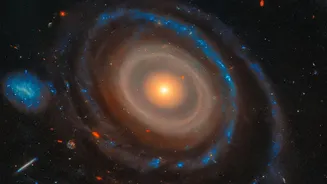
The slowdown isn't happening uniformly across the galaxy. Researchers discovered that much of Andromeda's recent star-forming activity has been concentrated in a massive ring of gas and dust located about 32,000 light-years from the galactic centre. It is the decreasing activity within this once-hyperactive ring that is driving the majority of the galaxy's overall decline in star birth. This suggests the galaxy isn't running out of the raw material needed to make stars; rather, it is taking a 'breather' after a more energetic past, as lead author Tobin Wainer described it.
A Case of Galactic Interference?
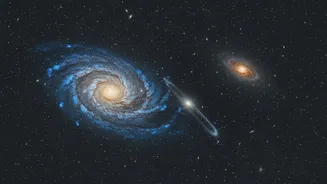
While the overall decline seems to be a natural part of Andromeda's lifecycle, the study also pointed to a potential local influence: the dwarf satellite galaxy M32. By examining the area of Andromeda closest to M32, astronomers found a distinct drop in star formation that began around 60 million years ago. While researchers cannot yet definitively say that an interaction with M32 caused this localised slowdown, they consider it the 'most likely suspect'. This finding could help astronomers constrain the timeline of past interactions between the two galaxies and understand how smaller galaxies can affect the evolution of their much larger hosts.