




A New Digital Tool for Lunar Science
In a major boost for the Artemis program and future lunar ambitions, NASA and IBM have released the NASA-IBM Lunar Foundation Model. This isn't just another piece of software; it's what's known as a foundation model, a type of AI pre-trained on an enormous
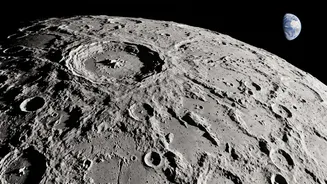
amount of data, which can then be adapted for a wide range of tasks. For decades, NASA has collected petabytes of information about the Moon, especially from its Lunar Reconnaissance Orbiter (LRO), which has gathered more data than all other NASA planetary missions combined. Sifting through this mountain of images and sensor readings has been a slow, painstaking process for researchers. This new AI aims to change that, acting as a powerful mapping tool to help scientists analyze the vast dataset faster than ever before.
What Exactly Is a Foundation Model?
Think of a foundation model as a university graduate with a broad, general education. Instead of being trained for one highly specific job, it has learned a wide range of fundamental concepts. The Lunar Foundation Model was trained on roughly two million image tiles from the LRO mission, learning the intricate details of the Moon's surface. This broad training allows it to spot patterns and connections that specialized, single-task AIs might miss. Because it already has this foundational knowledge, scientists don't have to build new AI models from scratch for every new research question. They can simply fine-tune the existing model for specific tasks, saving immense amounts of time and computational resources.
Unlocking the Moon's Biggest Mysteries
The immediate applications for this AI are crucial for humanity’s return to the Moon. One of its primary jobs is to help find resources, particularly water ice, which is believed to be hidden in permanently shadowed craters at the lunar poles. This ice could be a game-changer for future astronauts, providing drinking water, breathable oxygen, and even rocket fuel. The model is already outperforming previous methods in identifying areas with high potential for ice. It is also being used to map craters with greater accuracy to find safe landing zones, and to study unusual volcanic features called irregular mare patches. These patches could rewrite our understanding of the Moon's geological history.
The Game-Changing Power of Open Source
Perhaps the most significant aspect of this collaboration is that the model is open-source. It is publicly available on Hugging Face, a popular platform for sharing AI models, with the full codebase accessible for anyone to use and experiment with. This move democratizes lunar science, empowering a global community of researchers—from large institutions to university students in India and around the world—to contribute to our understanding of the Moon. By making the tool accessible to all, NASA and IBM are hoping to spark a wave of innovation and accelerate the pace of discovery. This collaborative approach ensures that the benefits of this powerful technology are shared widely.
From the Moon to Planet Earth
While its current focus is our celestial neighbour, the technology behind the Lunar Foundation Model has its roots in Earth science. It is part of a larger partnership between NASA and IBM to use AI for science, which has already produced the "Prithvi" family of models. These AI systems are designed to monitor our home planet by tracking deforestation, predicting crop yields, and mapping the impact of natural disasters like floods and wildfires. The success of these Earth-focused models provided the template for the lunar version. Looking forward, the principles behind this technology could be applied to explore other planets and moons in our solar system, turning AI into an indispensable co-pilot for future deep-space missions.