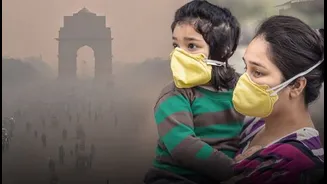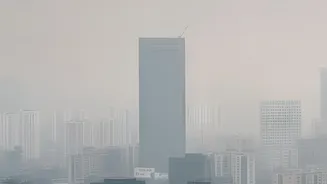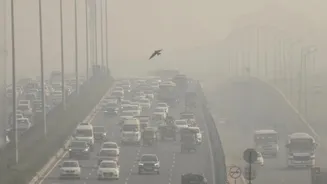









As winter descends on Delhi, the familiar haze returns, and with it, a persistent, scratchy throat. This guide explains why smog irritates your throat and how N95 masks offer crucial protection for essential outdoor trips.
Understanding 'Smog Throat'
That constant tickle or burning
sensation in your throat is a direct response to the air you're breathing. Delhi's air during high-pollution periods is a toxic cocktail of fine particulate matter (PM2.5), nitrogen dioxide, and other irritants. These microscopic particles bypass your body's natural defences and lodge in your respiratory tract, causing inflammation, dryness, and soreness. Your body's attempt to clear these pollutants can trigger a persistent dry cough, hoarseness, and a general feeling of discomfort.
Why Cloth Masks Are Not The Answer
While any face covering is better than none, standard cloth or surgical masks offer minimal protection against the primary culprit: PM2.5. These masks are designed to block larger droplets but are not effective at filtering the fine, invisible particles that penetrate deep into your lungs. Studies show that while a surgical mask's efficiency varies, an N95 respirator can filter over 95% of airborne particles when worn correctly, offering robust protection that cloth masks simply cannot match. Against the dense particulate pollution of Delhi, relying on a simple cloth mask for outdoor activity is insufficient.
N95 Masks: Your Best Defence Outdoors
For effective protection during 'Very Poor' or 'Severe' air quality days, experts recommend using a well-fitted N95 or a certified equivalent like a KN95 respirator. The 'N95' designation means the mask is certified to filter at least 95% of airborne particles as small as 0.3 microns. Since PM2.5 particles are larger than this, a properly worn N95 mask is highly effective at reducing your exposure. Given that Delhi's AQI frequently enters the 'Very Poor' and 'Severe' categories, with PM2.5 as a dominant pollutant, an N95 mask becomes an essential tool for anyone venturing outdoors.
How to Wear and Use Your N95 Correctly
An N95 mask is only effective if it forms a tight seal around your face. Any gaps will allow polluted air to leak in, defeating the purpose. To ensure a proper fit, first wash your hands and inspect the mask for damage. Place the mask under your chin with the nosepiece up. Pull the top strap over your head so it rests high on the back of your head; pull the bottom strap and position it around your neck, below your ears. Use fingertips from both hands to mould the metal nose clip to the shape of your nose. To check the seal, place your hands over the mask and exhale; you should not feel air leaking from the edges.
Beyond the Mask : Soothing an Irritated Throat
While masks are for protection, you can take additional steps to soothe a throat that is already irritated. Staying well hydrated by drinking plenty of water or warm liquids like herbal teas helps keep the throat's mucous lining moist. Gargling with warm salt water can reduce swelling and wash away irritants. At home, using a humidifier can combat the dry air that worsens throat irritation, and an air purifier with a HEPA filter can create a clean air zone, especially in the bedroom. Traditional remedies like ginger honey tea or turmeric milk may also provide temporary comfort.
When to Consult a Doctor
A pollution induced sore throat is typically temporary. However , you should seek medical advice if your symptoms persist for more than a week or are severe . Red flags include a high fever , difficulty swallowing or breathing , chest tightness , wheezing , or coughing up blood . For those with pre existing conditions like asthma or heart disease , it is crucial to be extra cautious and consult a doctor sooner if symptoms worsen . Do not self prescribe antibiotics , as they are ineffective against irritation caused by pollution .