



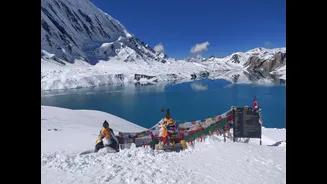

High in the Himalayas, new lakes are forming at an alarming rate. Fed by melting glaciers, these bodies of water are like ticking time bombs. A recent wave of research confirms the growing threat of Glacial Lake Outburst Floods, or GLOFs.
What is a Glacial Lake Outburst Flood?
As global temperatures
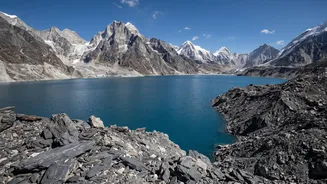
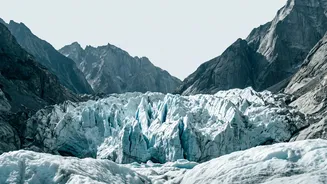
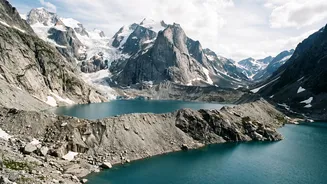
rise, glaciers in the Himalayas are retreating faster than ever. This meltwater often collects in depressions left behind by the ice, forming vast lakes. These are not like regular lakes; they are often held back by unstable, natural dams made of loose rock and debris called moraines. A Glacial Lake Outburst Flood (GLOF) occurs when this fragile dam fails. The trigger can be an avalanche of rock or ice crashing into the lake, an earthquake, or even just the pressure of the rising water. The result is a sudden, catastrophic release of millions of cubic metres of water, mud, and boulders, which surges down mountain valleys at immense speed, destroying everything in its path. It’s a force of nature that can reshape landscapes and devastate communities in a matter of hours.
New Studies Highlight a Growing Danger
Recent scientific reports paint a sobering picture of the escalating risk. A UN-led study, released ahead of the COP31 climate conference, found that the frequency of GLOF events has increased fivefold since 1950. Another study published in the journal 'Open Geosciences' focused on the Alaknanda Basin in the Indian Himalayas, revealing that dozens of new glacial lakes have formed in just three decades. Researchers found that between 1994 and 2023, the total area of the lakes they studied grew by 67%. This rapid expansion means more water is being stored behind already precarious dams, significantly increasing the potential for larger, more destructive floods. These findings are not just academic; they serve as an urgent warning for downstream populations.
India's Alarming Vulnerability
For India, the GLOF threat is both severe and immediate. Despite having fewer recorded GLOF events than China, India has suffered the highest number of fatalities in the Hindu Kush Himalaya region, with over 6,100 deaths recorded between 1835 and 2025, according to a recent UN-led analysis. The devastating 2023 GLOF at South Lhonak Lake in Sikkim, which claimed dozens of lives and destroyed a major hydropower dam, was a stark reminder of this vulnerability. A National Disaster Management Authority (NDMA) report has identified nearly 200 high-risk glacial lakes across the Indian Himalayas. Sikkim is listed as the most susceptible state with 16 highest-risk lakes, followed by Himachal Pradesh with 14, and Uttarakhand with five. These are not distant threats; they are active risks looming over communities in several Indian states.
The Transboundary Challenge
The danger doesn't respect international borders. A GLOF originating in Nepal or Bhutan can have devastating consequences for communities in India. An outburst from Bhutan's Sintaphu Lake in late October 2026, for example, sent floodwaters down the Sankosh river and triggered alerts in West Bengal and Assam. This highlights a critical challenge: a disaster can start in one country and wreak havoc in another, making cross-border cooperation essential. Without shared data, coordinated monitoring, and joint disaster response plans, communities in downstream nations like India remain exposed to sudden floods that they have no way of predicting on their own.
The Path Forward: Monitoring and Mitigation
While the threat is daunting, it is not insurmountable. The key lies in shifting from a reactive to a proactive approach. This involves a combination of advanced monitoring and direct intervention. Experts are calling for a robust network to monitor high-risk lakes using both satellite data and on-the ground sensors to detect changes that could signal an impending outburst. For the most dangerous lakes, engineering solutions like controlled drainage, siphoning water to lower lake levels, and reinforcing moraine dams can reduce the hazard directly. Alongside these technical solutions, developing effective early warning systems and ensuring communities are prepared with clear evacuation plans are crucial last lines of defence that can save countless lives.