





India is home to breathtaking extremes that hold world records. From the tallest statues to the wettest landscapes, these places are major tourist draws. But what if some of these famous titles aren't quite as solid as they seem?
The Highest Road: A Shifting Title
For decades, travellers
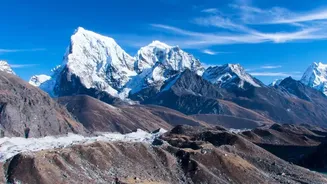
to Ladakh proudly held up photos at Khardung La, believed to be the world's highest motorable road at 18,380 feet. However, this long-held 'fact' is a classic case of a record needing a re-check. Independent GPS surveys and satellite data have since confirmed Khardung La's actual height is a still-impressive, but lower, 5,359 metres (17,582 feet). The title of the world's highest motorable road now belongs to Umling La, also in Eastern Ladakh, which was constructed by the Border Roads Organisation (BRO). Verified by Guinness World Records, Umling La sits at a staggering 19,024 feet (5,798 metres), connecting remote villages near the Indo-China border. This demonstrates how records are not always static; they can be corrected by better technology or surpassed by new achievements. The signs at Khardung La may not have changed, but the reality on the ground has.
The Wettest Place: A Tale of Two Villages
Which is the wettest place on Earth: Cherrapunji or Mawsynram? For years, school textbooks gave the title to Cherrapunji. Today, Guinness World Records officially recognizes Mawsynram for the highest average annual rainfall. Located just 15 kilometres apart in Meghalaya's Khasi Hills, the two villages are locked in a friendly rivalry. Mawsynram holds the record for the highest yearly average rainfall, at around 11,872 mm. However, the story is more nuanced. Cherrapunji (Sohra) still holds the all-time record for the most rainfall in a single year, a massive 26,471 mm recorded back in 1861. Meteorologists note that Cherrapunji also has a much longer history of continuous weather data collection. In any given year, one village might get more rain than the other, and a single extreme weather event can skew the numbers. The truth is, the entire region is the wettest inhabited place on the planet, making the 'winner' a matter of statistical perspective.
The Largest River Island: A Record Against Time
Majuli in Assam is recognised by Guinness World Records as the world's largest river island, a hub of Neo-Vaishnavite culture nestled in the mighty Brahmaputra river. But this is a record fighting a battle against nature. At the start of the 20th century, Majuli covered an area of about 1,250 square kilometres. Due to aggressive and continuous erosion from the Brahmaputra, its area had shrunk to just 352 square kilometres by 2014. Some estimates suggest it has lost a third of its landmass in just the last few decades, with dozens of villages washed away. While it still holds the official title, its physical reality is changing every monsoon season. This makes Majuli a poignant example of a record that is fragile and under constant threat from environmental forces, reminding us that some world records are not permanent monuments but delicate, shifting landscapes.
The Tallest Statue: A Clear and Present Record
Not all records are murky. The Statue of Unity in Gujarat is a clear-cut, verifiable world record holder. Standing at 182 metres (597 feet), it is officially the world's tallest statue, towering over the previous record-holder, China's Spring Temple Buddha. Inaugurated in 2018, this colossal monument dedicated to Sardar Vallabhbhai Patel is a modern engineering feat. Its height, location, and construction are all well documented and confirmed by global authorities like Guinness World Records. Unlike titles that rely on historical data or are subject to natural change, the Statue of Unity's claim is straightforward to measure and validate. It serves as an important counterpoint, showing that many record holding titles in India are accurate, impressive, and a source of national pride.