



A New Eye on the Cosmos
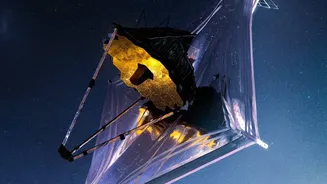
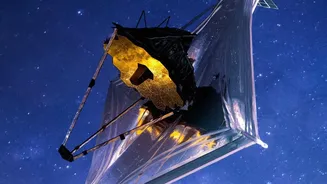
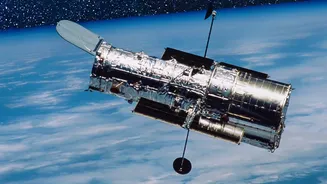
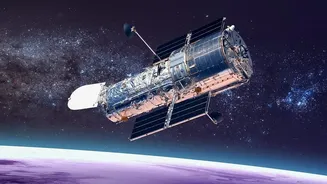
Launched in August 2026, the Nancy Grace Roman Space Telescope is NASA's next great observatory, joining giants like Hubble and JWST in exploring the universe. But while its mirror is the same size as Hubble's, Roman is built for a different purpose:
speed and scale. Its Wide Field Instrument can see a patch of sky at least 100 times larger than Hubble can, allowing it to survey vast swathes of the cosmos with incredible efficiency. One researcher noted that Roman can accomplish in one year what would have taken Hubble a thousand years. While its primary goals include mapping the influence of dark energy and dark matter, one of its most exciting tasks is to conduct a massive census of exoplanets, which will provide a treasure trove of data for understanding how planetary systems form.
Two Ways to Build a World
The story of planet formation has long had two competing main characters. The first, and most widely accepted, is 'core accretion'. In this model, planets form from the bottom up. Dust particles in the disk around a young star stick together, growing into pebbles, then boulders, and eventually into massive rocky cores. Once a core is large enough, its gravity begins pulling in vast amounts of gas from the surrounding disk, creating a gas giant like Jupiter. The second theory is 'gravitational instability'. This is a top-down approach where a massive, unstable protoplanetary disk rapidly cools and collapses under its own gravity, forming giant planet-sized clumps directly. While core accretion is excellent at explaining planets close to their stars, like those in our solar system, it struggles to explain massive planets found very far from their suns. Gravitational instability could be the answer in those cases, but evidence has been scarce.
The Microlensing Magnifying Glass
To solve this puzzle, Roman will employ a clever technique called gravitational microlensing. Based on Einstein’s theory of general relativity, this method relies on the fact that massive objects warp the fabric of space-time. When a star and its planets happen to pass almost directly in front of a more distant star from our point of view, their gravity acts like a natural magnifying glass. This causes the background star to temporarily brighten. If the foreground star has a planet, the planet’s own smaller gravity creates a secondary, briefer spike in brightness. This allows Roman to detect planets without ever seeing them directly, including worlds much colder, smaller, or farther from their star than other methods can typically find.
A Statistical Powerhouse
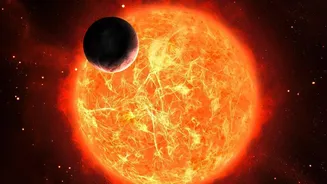
Previous planet-hunting methods, like the transit method used by Kepler, are most sensitive to large planets orbiting very close to their stars. This has given us a somewhat biased view of the galactic planetary population. Roman's microlensing survey will completely change the game. By staring at the dense star fields toward the center of our galaxy for extended periods, it is expected to discover thousands of new exoplanets. Crucially, this method is most sensitive to planets from their star's habitable zone outwards, filling a major gap in our knowledge. It will find analogues to all the planets in our solar system, from Mars-mass worlds to distant ice giants. This huge and unbiased dataset will provide the first real statistical census of planets in the outer regions of star systems.
Putting Theories to the Test
The data from Roman's survey will allow scientists to finally test the competing formation theories on a galactic scale. If core accretion is the dominant process everywhere, we should find a decreasing number of giant planets the farther we look from a star. But if gravitational instability is a common way to form planets in the frigid outer reaches of a solar system, Roman should find a population of massive gas giants in very wide orbits that core accretion struggles to explain. The survey is also expected to find hundreds, if not thousands, of 'rogue planets'—worlds that roam the galaxy untethered to any star. The abundance and mass of these free-floating planets could be a key clue, as they may be worlds that were ejected from their systems—a potential outcome of both formation models.