


The gold in your jewellery and the platinum in industrial machinery all have a violent, cosmic origin. For decades, a key question for astronomers has been where exactly these heavy elements are made. Now, a mysterious glow may hold the answer.
A Cosmic Whodunit
Our universe
began with the simplest elements: hydrogen and helium. All the heavier elements we know today were forged inside stars through nuclear fusion, up to and including iron. But to create elements heavier than iron—like gold, platinum, and uranium—you need an even more extreme environment with an incredible density of free neutrons. This happens through a mechanism called the rapid neutron-capture process, or 'r-process'. For a long time, scientists debated the primary location of these cosmic factories. Supernova explosions were one candidate, but evidence has increasingly pointed to an even more cataclysmic event: the merger of two neutron stars.
The Kilonova Hypothesis
Neutron stars are the ultra-dense cores left behind after massive stars die. Imagine an object more massive than our sun, crushed into a sphere the size of a city. When two of these stellar remnants orbit each other, they gradually spiral inward, ultimately colliding in a spectacular explosion known as a 'kilonova'. This violent merger is believed to be the perfect pressure cooker for the r-process, flinging vast quantities of newly-formed heavy elements out into space. In 2017, the gravitational wave event GW170817 provided the first direct evidence, as astronomers detected both the merger and the chemical signature of heavy elements in its aftermath. But finding the leftover remnants of these events has proven difficult.
A Mysterious Glow in the Milky Way
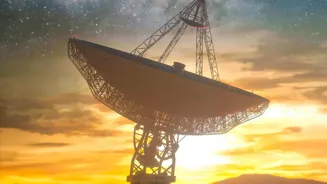
Recently, researchers turned their attention to a curious source of high-energy gamma rays known as HESS J1507−622. First detected between 2006 and 2007 by the H.E.S.S. telescope array in Namibia, this object has puzzled astronomers for years. It emits powerful gamma rays but has no corresponding signal in other wavelengths like X-rays or radio waves. Crucially, it's also located away from the main plane of our galaxy, where most stars and known energy sources reside. This unusual combination of features led scientists to propose a new, compelling theory: HESS J1507−622 could be the remnant of a kilonova.
Connecting the Dots
According to a new study, the unique properties of HESS J1507−622 are a strong match for what a young kilonova remnant should look like. The researchers modelled a hypothetical collision and calculated the radiation that its remnant would produce over time. Their analysis showed that a kilonova remnant younger than 1,000 years could reproduce the specific gamma-ray emissions observed from HESS J1507−622. Because it lies outside the galactic plane, a likely origin story involves a pair of neutron stars that were 'kicked' out of a star cluster before eventually merging. If confirmed, this would be the very first kilonova remnant identified within our own Milky Way galaxy.
The Search for Cosmic Goldmines
Confirming the nature of HESS J1507−622 would be a monumental step in astrophysics. It would provide a local laboratory for studying the r-process and give us a tangible link to the origin of the heaviest elements that have been incorporated into stars, planets, and even life itself. While the study is still awaiting peer review, it offers the most convincing explanation to date for this long-standing astronomical mystery. The discovery provides a thrilling new target for astronomers, who will now use other powerful telescopes to search for further clues in and around the remnant. The investigation into this bright, young object represents a hunt for one of the universe's most elusive and important factories—the cosmic goldmines responsible for creating the precious elements that enrich our galaxy.