






The Universe's Missing Ingredient
For decades, physicists have been confronted with a profound puzzle. The way galaxies spin and the way light bends around massive objects suggest there is far more gravitational pull than we can account for with visible stars, planets, and gas. This missing
mass, which doesn't seem to emit or reflect any light, has been dubbed 'dark matter'. Scientists are certain it exists due to its immense gravitational effect, acting like an invisible cosmic glue holding galaxies together. It’s believed to make up about 85% of all matter in the universe, yet despite decades of searching, its true nature remains one of the greatest open problems in modern science. We know it's there, but we don't know what it is.
Thinking Outside Our Four Dimensions
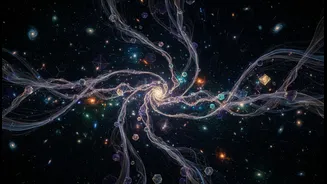
To solve this mystery, some physicists look beyond our everyday experience of three spatial dimensions and one time dimension. Theories involving extra dimensions, often associated with string theory, propose that our universe is like a surface, or 'brane', existing within a higher-dimensional space called the 'bulk'. While our particles and forces (like electromagnetism) might be stuck on our brane, a force like gravity could potentially travel through these extra dimensions. This could explain why gravity is so much weaker than other forces. The idea, while mind-bending, is a serious mathematical framework for exploring the fundamental nature of reality.
Sheffield's Resonant Connection
The new study from the University of Sheffield, published in the journal Physical Review D, proposes a compelling new bridge between these two giant mysteries. The team, led by Dr. Yu-Dai Tsai, suggests that dark matter particles might exist in a hidden fifth dimension alongside a hypothetical particle known as a 'dark photon'. The crucial part of their theory is that the specific geometry of this extra dimension naturally causes the masses of these particles to align in a precise way, creating a phenomenon called 'dark matter resonance'. This is similar to how a musical instrument vibrates intensely when it hits just the right note. This resonance could have made dark matter interact strongly in the early universe, before becoming almost undetectable today.
A Natural Fit, Not A Forced One
What makes the Sheffield theory so compelling is that it elegantly solves a problem with previous models. In the past, scientists who explored similar ideas had to meticulously 'fine-tune' the assumed masses of particles by hand to make their theories work. The new proposal suggests this perfect tuning isn't a coincidence but a natural consequence of the geometry of the hidden dimension itself. As Dr. Tsai explained, while dark matter resonance is a known and powerful idea, this new work gives it a deeper origin. Instead of being an assumption, the resonance may come directly from the mathematical structure of the hidden dimension. This provides a more fundamental and less artificial explanation for how dark matter behaves.
New Targets in an Invisible Hunt
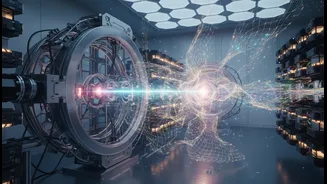
This framework doesn't just tidy up a theoretical loose end; it gives experimental physicists clear new targets in their search for dark matter. By connecting the mystery of dark matter to the existence of hidden dimensions, the theory suggests new ways dark matter might have been produced in the early universe and, therefore, new ways we might search for it today. While still a theory, it provides a testable hypothesis that could guide future experiments at facilities like the Large Hadron Collider or in sensitive underground detectors. The search for dark matter has even driven practical technological advances in areas like medical imaging and computing, thanks to the development of ultra-sensitive measurement technologies.