






The Beating Heart of a Distant World
When NASA’s New Horizons spacecraft flew past Pluto in 2015, it revealed a stunning feature: a bright, heart-shaped region now known as Tombaugh Regio. The western lobe of this heart, a vast basin called Sputnik Planitia, immediately captivated scientists.
Larger than Texas and Oklahoma combined, it's not made of water ice, but a massive glacier of frozen nitrogen, methane, and carbon monoxide. Most strikingly, its surface was almost completely free of impact craters, a tell-tale sign that the landscape was geologically young and being actively renewed. Before this flyby, many expected Pluto to be a cold, dead, and heavily cratered ball of ice, having long ago lost any internal heat needed to power geological activity. The images sent back proved that assumption spectacularly wrong.
A Cosmic Lava Lamp of Frozen Nitrogen
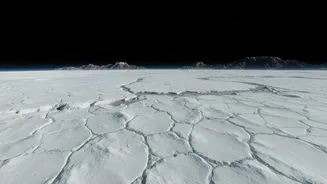
The surface of Sputnik Planitia is broken up into city-sized polygonal shapes, separated by narrow troughs. Scientists quickly realized these were convection cells, similar to the patterns you might see in a pot of simmering soup or a lava lamp. In this case, the 'lava' is solid nitrogen ice. Warmed by Pluto’s modest internal heat, the slightly warmer, more buoyant ice from the bottom of the glacier slowly rises in the center of the cells. As it reaches the frigid surface, where temperatures hover around minus 230 degrees Celsius, it cools, becomes denser, and sinks back down along the cell boundaries. This constant, slow-motion churning, taking place over hundreds of thousands of years, continually resurfaces the glacier, erasing craters and keeping it looking pristine.
New Signs of Life at the Edges
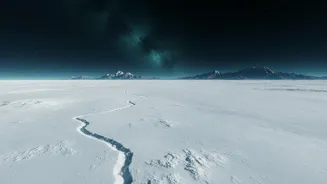
The latest findings, published in the Planetary Science Journal, focus on the boundaries between these massive ice cells. A re-analysis of the New Horizons imagery has revealed dark streaks and diffuse patches along the northern rim of Sputnik Planitia. According to researchers, these features strongly resemble patterns seen on Earth's glaciers where liquid water has emerged from beneath the ice and wetted the surface. Since liquid water is impossible on Pluto's frozen surface, and nitrogen rain is impossible in its thin atmosphere, scientists have concluded that liquid nitrogen may be welling up from below. Computer models suggest that under the immense pressure at the base of the kilometers-deep glacier, solid nitrogen can melt. This liquid then seeps upward through cracks and fractures in the ice, temporarily flowing onto the surface before refreezing.
Rewriting the Rules for Icy Worlds
The discovery of recently flowing liquid on Pluto is a game-changer. It provides the strongest evidence yet that the dwarf planet remains geologically active today. The existence of such processes was highly unexpected for a small body so far from the Sun, which lacks a large nearby planet to generate heat through tidal forces. It suggests that even small, cold worlds can retain enough internal heat from their formation and the decay of radioactive elements to power complex geology. This finding forces a rethink of what it means for a world to be 'active'. It implies that similar processes could be happening on other distant, icy bodies in our solar system, like Neptune's moon Triton or the dwarf planet Eris. Pluto is no longer seen as a static relic at the edge of the solar system, but as a dynamic and evolving world.