


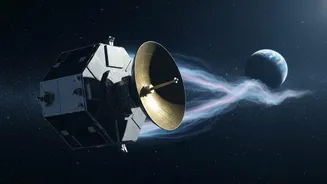
Our Sun’s Protective Bubble
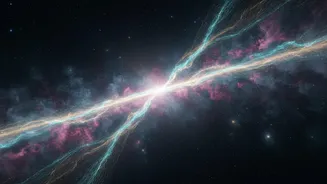
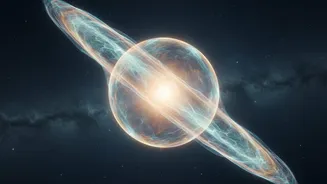
The space around our solar system isn't empty. It's filled with a constant stream of charged particles flowing from the Sun, known as the solar wind. This wind travels billions of kilometres in all directions, inflating a vast magnetic bubble called the heliosphere.
This bubble envelops all the planets, from Mercury to Neptune and far beyond, acting as the primary sphere of the Sun's influence. Essentially, it is the Sun's outer atmosphere, separating our planetary neighbourhood from the rest of the Milky Way galaxy. The heliosphere is a dynamic structure, shaped like a comet with a long tail, that moves through interstellar space as our Sun orbits the center of the galaxy.
A Shield Against Cosmic Dangers
The heliosphere is more than just a boundary; it's a critical shield. Without it, life on Earth might have evolved very differently, if at all. It protects our solar system from a significant amount of dangerous galactic cosmic rays—highly energetic particles often originating from distant supernova explosions. These particles can damage living cells and interfere with sensitive electronics. While Earth's own magnetic field provides a layer of protection, the heliosphere is our first and largest line of defence, deflecting much of this harmful radiation before it can ever reach the inner solar system. Understanding its structure and behaviour is key to comprehending what makes a solar system habitable.
Meet NASA’s New Cosmic Cartographer
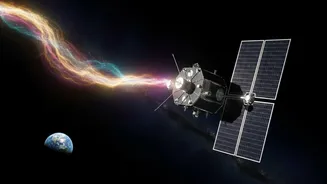
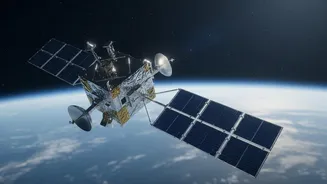
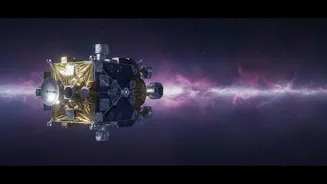
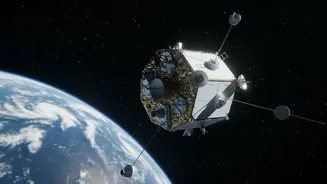
To get a better look at this cosmic shield, NASA launched the Interstellar Mapping and Acceleration Probe, or IMAP, in September 2025. This advanced spacecraft is designed to be a modern-day celestial cartographer, mapping the boundaries of the heliosphere in unprecedented detail. IMAP is equipped with ten scientific instruments that study the solar wind, the particles from interstellar space, and the complex interaction between them. It does this by collecting and analysing particles, particularly Energetic Neutral Atoms (ENAs), which are created at the edge of the solar system and travel in straight lines, carrying information about their origin. By tracing these messengers, scientists can build a comprehensive map of this otherwise invisible frontier.
What the First Data Reveals
In a major milestone announced recently, NASA has made the first public release of science data from seven of IMAP's ten instruments. This initial dataset, collected as the spacecraft journeyed to its operational orbit about 1.5 million kilometres from Earth, provides a fresh glimpse into the solar wind's properties and the interplanetary magnetic field. While still preliminary, the data from instruments like the Solar Wind and Pickup Ion (SWAPI) instrument and the High-energy Ion Telescope (HIT) have started to fill in the blanks on how particles from the Sun and deep space are energised and distributed. This information is the first step toward creating the most detailed map of the heliosphere's boundary ever attempted, building on the legacy of the Voyager and IBEX missions.
Why This Matters for Us on Earth
A better understanding of the heliosphere has direct practical benefits. IMAP's observations are crucial for improving space weather forecasting. The spacecraft can provide about a 30-minute advance warning of incoming hazardous solar radiation, which can disrupt power grids on Earth and damage satellites. This early warning system is vital for protecting our technological infrastructure and ensuring the safety of astronauts, especially as humanity plans for long-duration missions to the Moon and Mars with programs like Artemis. By studying our own cosmic shield, we not only protect ourselves but also learn about the conditions that might make other star systems capable of supporting life.