
The Sun’s Invisible Haymaker
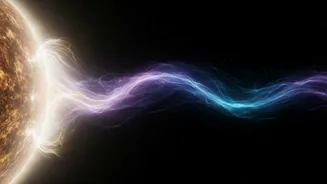
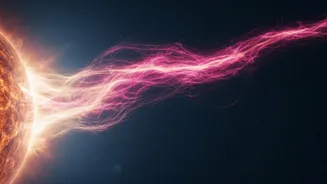
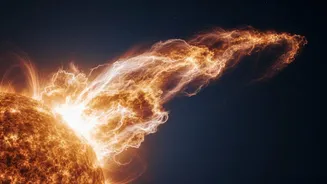
The Sun, the source of all life on Earth, occasionally throws a punch. These come in the form of coronal mass ejections (CMEs), which are gigantic explosions of plasma and magnetic fields from the Sun's outer atmosphere. When a CME is aimed at Earth, it
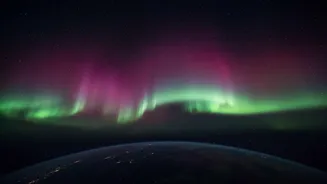
can trigger a geomagnetic storm, a major disturbance of our planet's magnetic field. While these storms can produce beautiful auroras, they also pose a significant threat to the technology-dependent society we have built. History provides stark warnings. The 1859 Carrington Event, the most powerful geomagnetic storm on record, set telegraph offices on fire. A much weaker storm in 1989 caused a nine-hour blackout across the entire province of Quebec, Canada. Today, with our reliance on a delicate web of satellites for communication and GPS, and vast, interconnected power grids, the potential damage from a major solar storm is orders of magnitude greater.
A New Watchman in the Sky
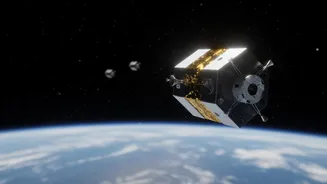
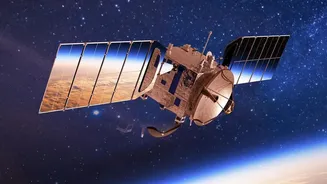
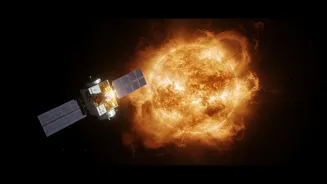
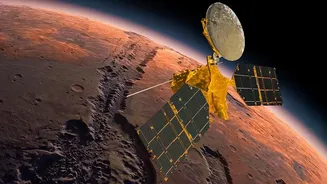
Until recently, forecasting the arrival of a CME was fraught with uncertainty. Scientists could see a storm leave the Sun but would often lose sight of it across the vastness of space, leaving them to guess its speed and trajectory. This changed in March 2025 with the launch of NASA's PUNCH mission, which stands for Polarimeter to Unify the Corona and Heliosphere. The mission consists of four suitcase-sized satellites flying in formation in low-Earth orbit. Working together, they act as a single, wide-field observatory, capturing images of the solar wind—the stream of particles constantly flowing from the Sun—and any CMEs travelling within it. By taking a new image every four minutes, PUNCH can track a solar storm nearly its entire journey from the Sun to Earth, filling in a massive blind spot that has long hampered forecasters.
A Stunning Leap in Forecasting
In a groundbreaking proof-of-concept test announced in August 2026, scientists used PUNCH's data to achieve a stunning new level of accuracy. Using images of a CME that erupted on May 31, 2025, they fed the data into a computer model. The model analyzed the leading edge of the expanding cloud of plasma to calculate its speed and geometry. Twelve hours after the CME left the Sun, the model locked in a final prediction: the storm would arrive at Earth eight hours later. This prediction was accurate to within 30 minutes. This represents a tenfold improvement over previous methods, which often had an error window of five hours or more. “We accomplished an order of magnitude better result than the state-of-the-art method with a really basic process,” said Craig DeForest, the mission's principal investigator.
Protecting Our Connected World
An accurate forecast is more than just a scientific achievement; it's a vital tool for protecting critical infrastructure. Geomagnetic storms can induce powerful electrical currents in long conductors like power lines. These currents can overload and damage high-voltage transformers, leading to widespread and long-lasting blackouts. For satellites, the consequences can be just as severe, with the potential for disrupted communications, corrupted GPS signals, and even permanent damage to sensitive electronics. An early warning system that provides hours or even days of notice allows power grid operators to re-route energy and take preventative measures. Satellite operators can place their spacecraft into a protective safe mode, shielding them from the worst of the storm. The advance notice provided by missions like PUNCH transforms space weather from an unpredictable threat into a manageable risk, safeguarding the technologies that underpin our economy and daily lives.