






Your Body's Miniature Stand-In
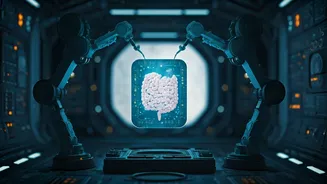
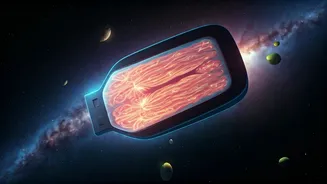
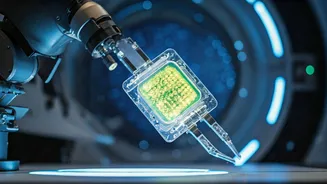
The 'tissue models' NASA is sending to space are not what you might picture. They are sophisticated devices called 'organ chips' or 'tissue chips'. Imagine a small, clear plastic block, about the size of a USB stick, laced with microscopic channels. Inside
these channels, scientists grow living human cells in a 3D structure that mimics the function of a specific organ, like the bone marrow, heart, or lungs. A system of tiny tubes provides a constant flow of nutrients and oxygen while removing waste, just like blood vessels do in your body. This technology creates a functional, miniature model of a human organ, allowing researchers to study its behaviour in ways they never could before. Essentially, they are creating a biological avatar for an astronaut.
The Hazards of Deep Space
Low Earth orbit, where the International Space Station resides, is relatively safe thanks to Earth's protective magnetic field. This bubble shields astronauts from the worst of space radiation. But deep space, the vast expanse between planets, is a different story. On a mission to the Moon or Mars, astronauts would be constantly bombarded by two main types of radiation: solar particle events from the sun and, more concerningly, galactic cosmic rays (GCRs). These high-energy particles, remnants of distant supernovae, can tear through spacecraft and human tissue, damaging DNA and wreaking havoc on cells. This exposure significantly increases the long-term risk for cancer, cardiovascular disease, and central nervous system damage. These tissue chips are being sent on missions like Artemis II to experience this harsh environment firsthand.
Studying the Invisible Damage
The primary goal of sending these organ chips into deep space is to get a clear picture of what this radiation does to human biology at a cellular level, without putting a human at risk. The AVATAR (A Virtual Astronaut Tissue Analog Response) program, for example, focuses on bone marrow chips, as bone marrow is crucial for the immune system and is particularly vulnerable to radiation damage. By taking cells from the actual astronauts, scientists can create personalized chips that reveal how an individual's unique biology might react to the stressors of deep space. When the chips return to Earth, researchers can analyze them for changes in gene expression and cellular function, essentially reading a biological logbook of the journey. This provides an unprecedented level of detail on the damage caused and how to potentially prevent it.
Paving the Way for Mars
This research is not just an academic exercise; it is a critical step on the path to Mars. Understanding the specific ways deep space affects the body allows NASA to develop targeted countermeasures. This could mean creating new shielding for spacecraft, developing new drugs that protect against radiation damage, or even personalizing medical kits for each astronaut based on their genetic predispositions. Previous experiments on the space station have already shown that tissue chips are a viable way to test drugs that might prevent muscle and bone loss in microgravity. By using these biological avatars, NASA can test potential solutions much faster and more safely than would be possible with human trials alone, accelerating the development of technologies needed to keep astronauts healthy on a three-year round trip to the Red Planet.
Benefits for Us on Earth
The incredible technology being pushed forward by NASA's deep space ambitions has significant implications for healthcare back on Earth. The accelerated aging process seen in space can help scientists study age-related diseases like osteoporosis and immune system decline much more quickly. The insights gained from how bone marrow chips respond to radiation could lead to better, more targeted radiation therapy protocols for cancer patients, helping doctors predict and manage side effects. These organ-on-a-chip platforms are already transforming pharmaceutical research, providing more accurate models of the human body to test new drugs for safety and effectiveness. In a way, by preparing for the journey to other worlds, we are discovering revolutionary ways to improve and protect human life right here on our own.