




The Great Lunar Radio Shadow
The Moon is tidally locked with Earth, meaning it always shows us the same face. The hidden far side, therefore, remains in a constant radio shadow, physically blocked from direct line-of-sight communication. During the Apollo era, this forced a nerve-wracking
reality: every time an orbiter passed behind the Moon, all contact was lost. This communication blackout poses a significant obstacle for the ambitious goals of the Artemis program, which aims to establish a sustainable human presence and explore challenging regions like the lunar South Pole and far side. For complex science, robotic operations, and astronaut safety, intermittent contact is no longer enough.
Introducing LunaNet: An Internet for the Moon
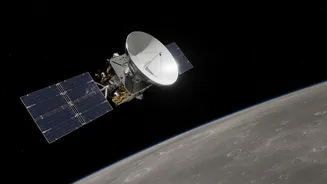
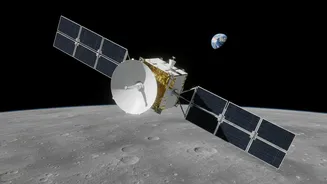
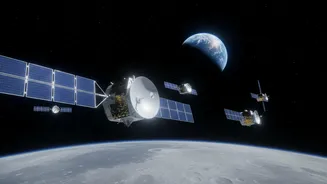
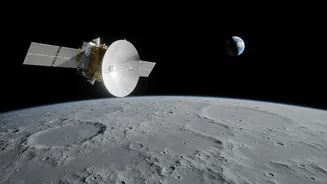
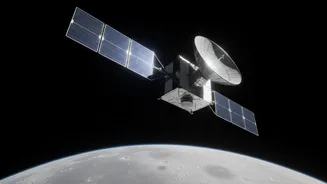
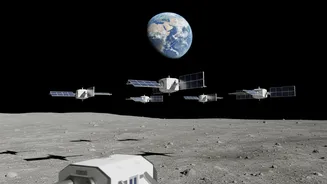
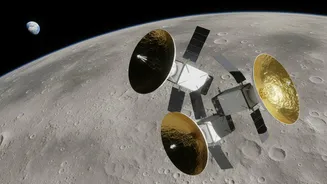
NASA's solution is an ambitious infrastructure project called LunaNet. Conceived as an internet-like service for the Moon, LunaNet is an architecture for a network of interconnected satellites and ground systems. At its core are relay satellites placed in specific lunar orbits. These satellites will act as routers in space, capable of seeing both assets on the lunar surface—even on the far side—and ground stations on Earth at the same time. By bouncing signals between these nodes, LunaNet will effectively eliminate the communications blackout that has defined far-side exploration for decades. NASA is partnering with commercial companies, such as Intuitive Machines, to develop and deploy these crucial relay services.
More Than a Phone Call Home
While enabling astronauts to speak with mission control is vital, LunaNet's capabilities go much further. The network is designed to provide three core services: networking, navigation, and science. The high-bandwidth connection will allow for the transmission of vast amounts of scientific data and even high-definition video from the lunar surface. Crucially, LunaNet will also provide Position, Navigation, and Timing (PNT) services, creating a lunar GPS system. This will allow rovers and astronauts to navigate the surface with unprecedented precision, independent of constant oversight from Earth. Furthermore, the network will provide real-time alerts for events like solar flares, significantly enhancing astronaut safety.
Powering the Artemis Generation
This robust communications and navigation infrastructure is not just an upgrade; it's a fundamental requirement for the Artemis program's long-term goals. Establishing a sustainable human presence, as envisioned by Artemis, means moving beyond the short, flag-planting missions of the past. It requires the ability to conduct complex construction, run long-duration experiments, operate sophisticated rovers, and ensure the safety of crews living and working on the Moon for extended periods. LunaNet provides the digital backbone for this entire enterprise, making it possible to coordinate multiple missions, manage lunar assets, and build the first permanent off-world outpost. It is a critical step in using the Moon as a proving ground for future missions to Mars.
An Interoperable Future
A key principle of LunaNet is that it is not a closed, proprietary system. NASA is designing it as an open, interoperable framework where international partners and commercial entities can contribute and use the network. The European Space Agency (ESA) and Japan's JAXA are already collaborating on the standards that will define this lunar internet. This approach mirrors the collaborative nature of modern terrestrial networks and is intended to foster a thriving cislunar economy. By creating a shared infrastructure, NASA is lowering the barrier to entry for a wide range of scientific and commercial missions, empowering a new generation of lunar exploration from a diverse group of global players.