






A New Era for Great Observatories
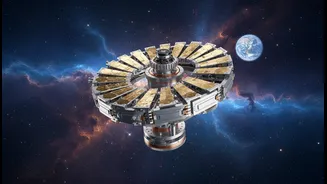
The Habitable Worlds Observatory (HWO) is NASA's next flagship astrophysics mission, slated for launch in the 2040s. Its primary goal is profound: to directly image and analyze the atmospheres of at least 25 Earth-like planets around Sun-like stars, searching
for chemical signs of life, or biosignatures, like oxygen and methane. This ambitious project, recommended by the National Academies' Astro2020 Decadal Survey, aims to build on the legacies of the Hubble and James Webb Space Telescopes. However, HWO represents a fundamental strategic shift. Unlike the James Webb, which was launched as a fixed, unserviceable instrument, HWO is being designed from the ground up with a key feature in mind: upgradability. This approach turns it from a single-mission instrument into a sustainable, long-term platform for discovery.
Learning from Hubble's Success
The value of in-space servicing was proven by the Hubble Space Telescope. Launched into low-Earth orbit, Hubble was visited by Space Shuttle astronauts five times for repairs and instrument upgrades. These missions fixed its initially flawed optics and repeatedly equipped it with newer, more powerful cameras and spectrographs, dramatically extending its scientific life and productivity far beyond its original projections. The James Webb Space Telescope, by contrast, operates 1.5 million kilometers from Earth at a location called L2, a gravitationally stable point that is ideal for observation but far beyond the reach of human service missions. HWO will also operate at L2, but NASA is mandating a new approach to overcome this distance.
Robots to the Rescue
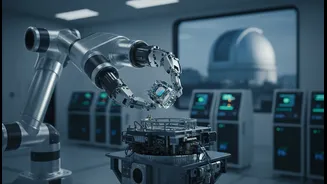
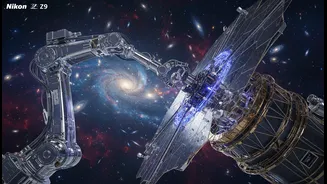
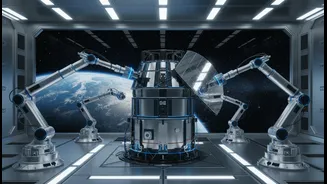
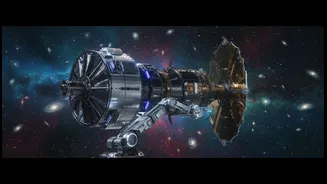
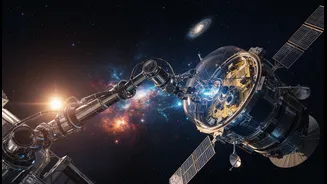
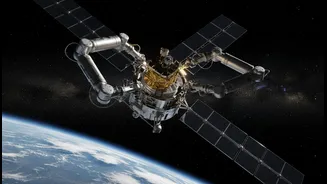
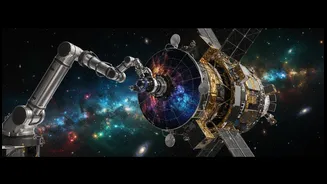
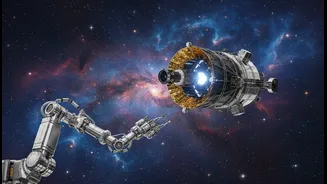
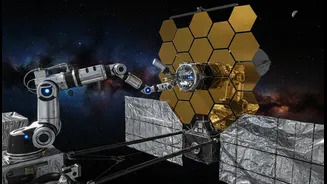
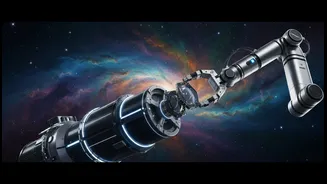
Since sending astronauts to L2 isn't feasible, HWO will be built for robotic servicing. The core idea is a modular design where critical components are configured as standardized, line-replaceable units. These modules, from scientific instruments and sensor arrays to command-and-control computers, will feature specialized docking interfaces and connectors optimized for robotic hands. In the future, NASA envisions autonomous or remotely operated spacecraft that can travel to HWO, latch on, slide out obsolete or failing instruments, and insert next-generation technology. This strategy not only allows for repairs but ensures the observatory can evolve, incorporating new scientific tools developed years or even decades after its initial launch.
A Sustainable Investment in Science
Designing a flagship observatory like HWO is an enormous undertaking with a projected cost of around $11 billion. Building for serviceability is a strategic decision to maximize the return on this massive investment. Rather than launching an entirely new multi-billion-dollar telescope every couple of decades, NASA can refresh and enhance HWO's capabilities for a fraction of the cost. This model also provides a powerful driver for the commercial space industry, creating a market for in-space servicing, assembly, and manufacturing (ISAM). Companies are already being awarded studies to explore how their on-orbit servicing technology can be integrated into the HWO mission from its earliest stages. This forward-thinking plan means HWO could still be at the forefront of astronomical research for generations to come.